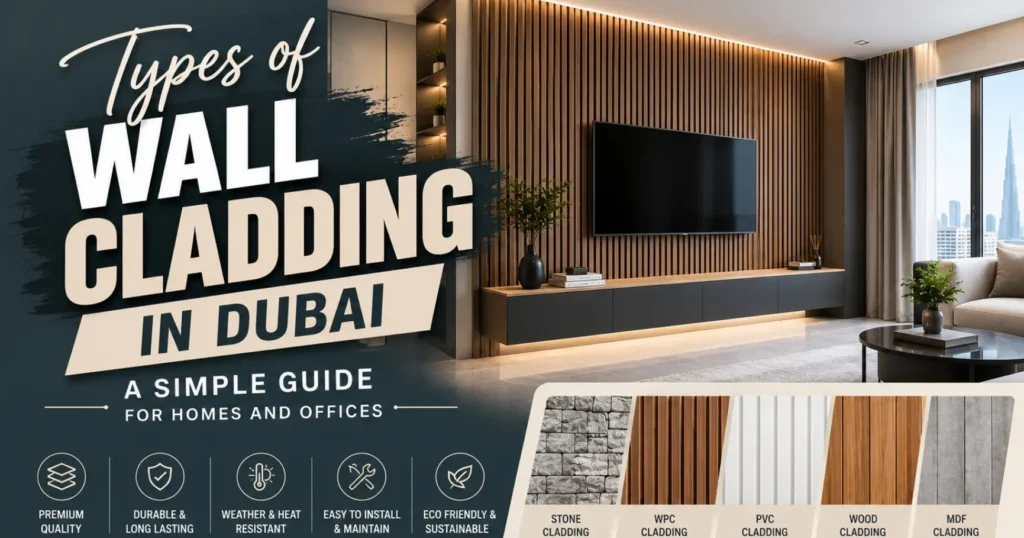
Choosing a wall finish in Dubai can be confusing. Every showroom shows you ten samples. Every supplier says theirs is the best. This guide clears that up. Below we explain the main types of wall cladding in Dubai in plain words. You will learn what each material is made of, where it works, and where it fails. No heavy technical talk. Just simple facts you can use before you place an order.
Dubai walls face a hard life. Summer heat crosses 45°C. Coastal humidity sits high for months. Fine desert dust settles on everything. So the right cladding here is not only about looks. It is about survival. The same rules apply to homes and offices, in residential and commercial buildings alike.
What Is Wall Cladding?
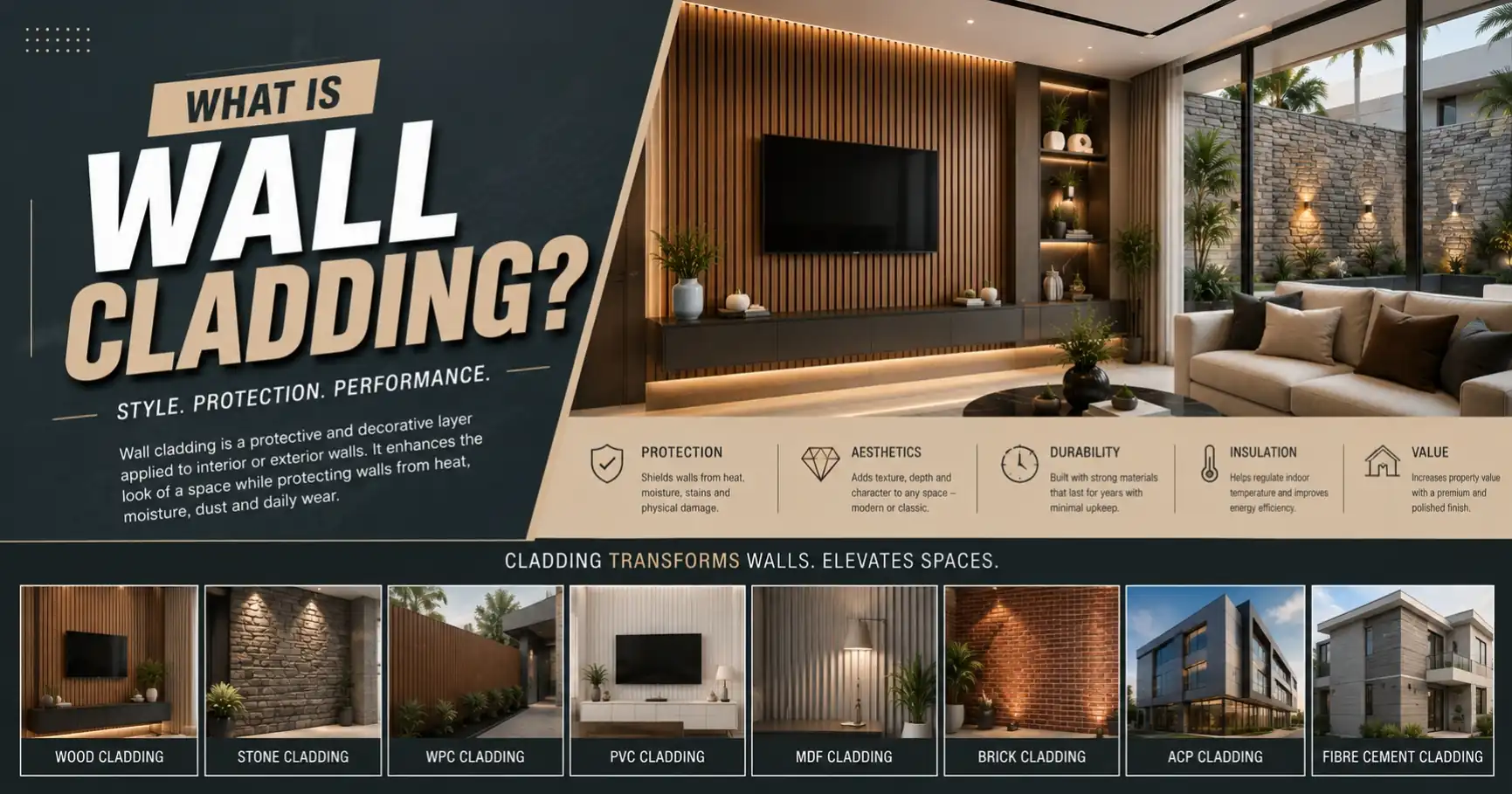
Cladding is a second skin for your wall. It is a layer of material fixed over the original surface, which is why many people simply call it a wall covering. That layer takes the damage instead of your wall.
It does four jobs at once:
- It hides cracks, patches, and old paint marks.
- It blocks moisture, dust, and daily knocks.
- It adds texture and colour to a flat room.
- It can cut heat transfer and reduce noise.
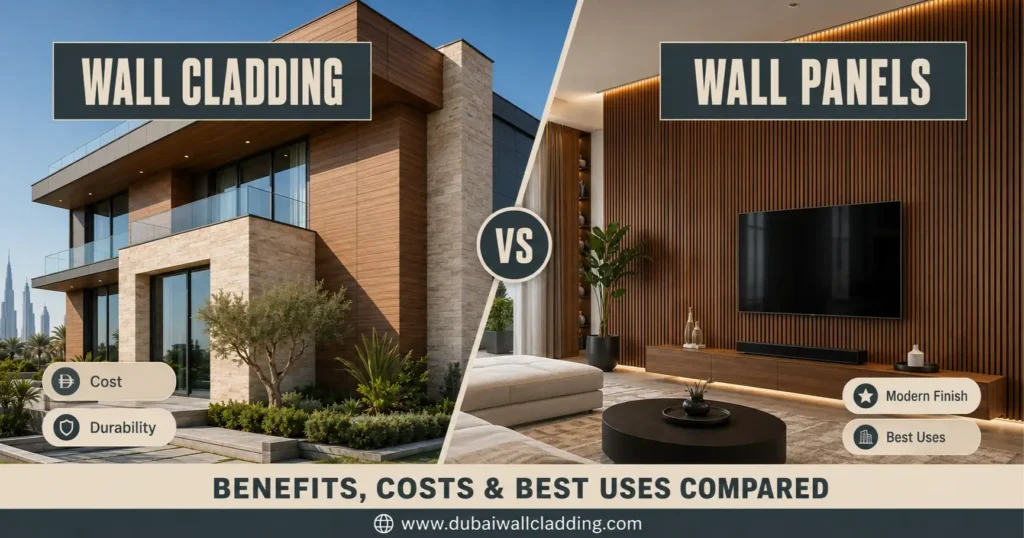
People often mix up cladding and wall panels. The line is thin. Cladding usually means a full system built for protection. A decorative wall panel usually means a single board fixed for interiors. In daily use, both words are used for the same thing. Wall panels in Dubai are sold everywhere, from trade showrooms to online stores, so the label on the box matters less than the material inside it.
Why Cladding Makes Sense in Dubai
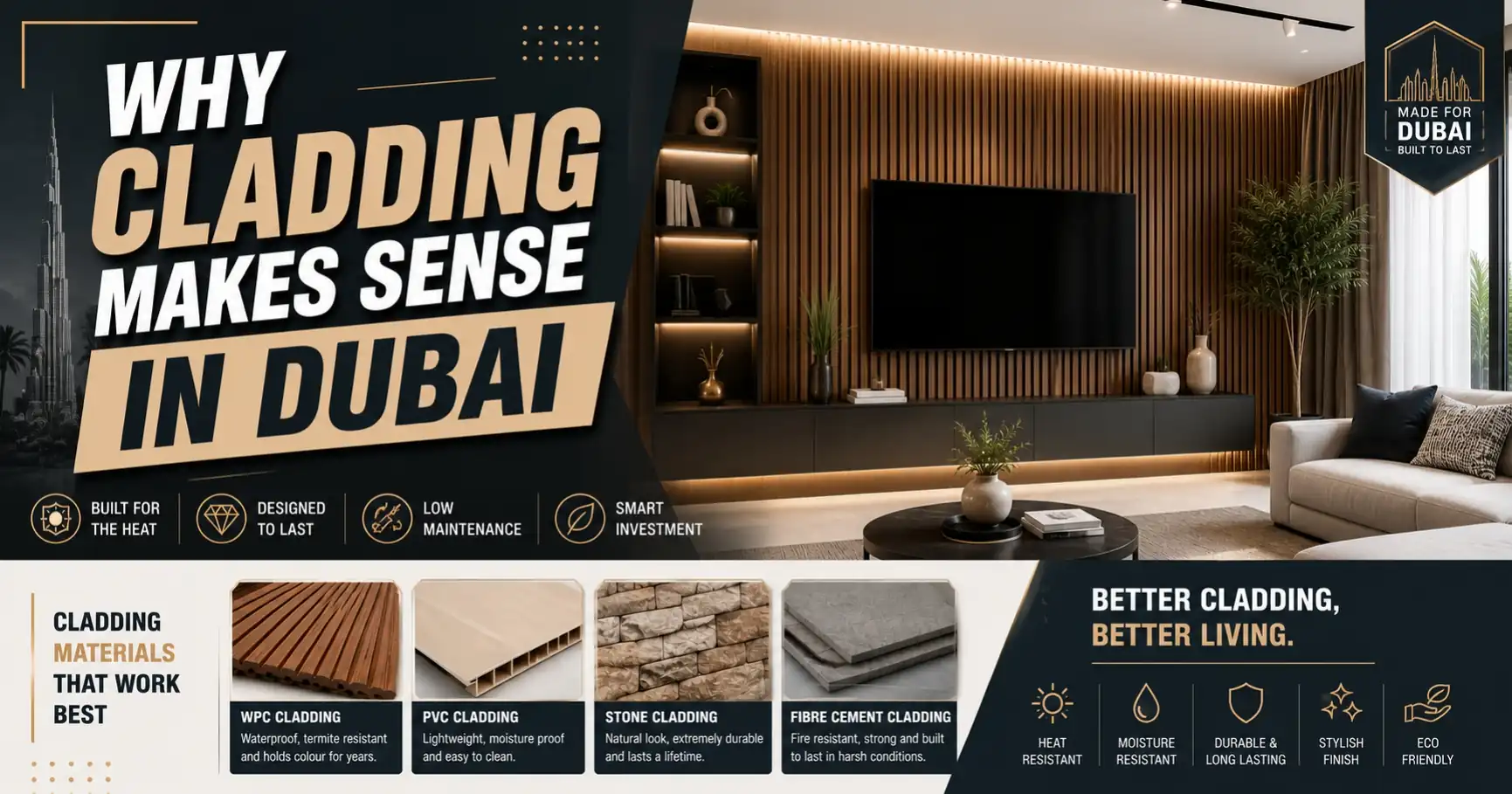
Paint looks fresh for two years here. Maybe three. Then the sun fades it. Humidity lifts it near bathrooms. Dust dulls it on outdoor walls.
Cladding lasts far longer. A good PVC or WPC surface holds its colour for a decade. Stone and fibre cement can last much longer than that. You pay more once. Then you stop repainting every second year. It is also low maintenance. Dust wipes off, and most surfaces are easy to clean with plain water.
There is a comfort benefit too. Villas here run air conditioning almost all year. A clad wall slows heat coming through the surface. That means the AC works a little less. Over a full summer, the saving is real.
Main Types of Wall Cladding Dubai
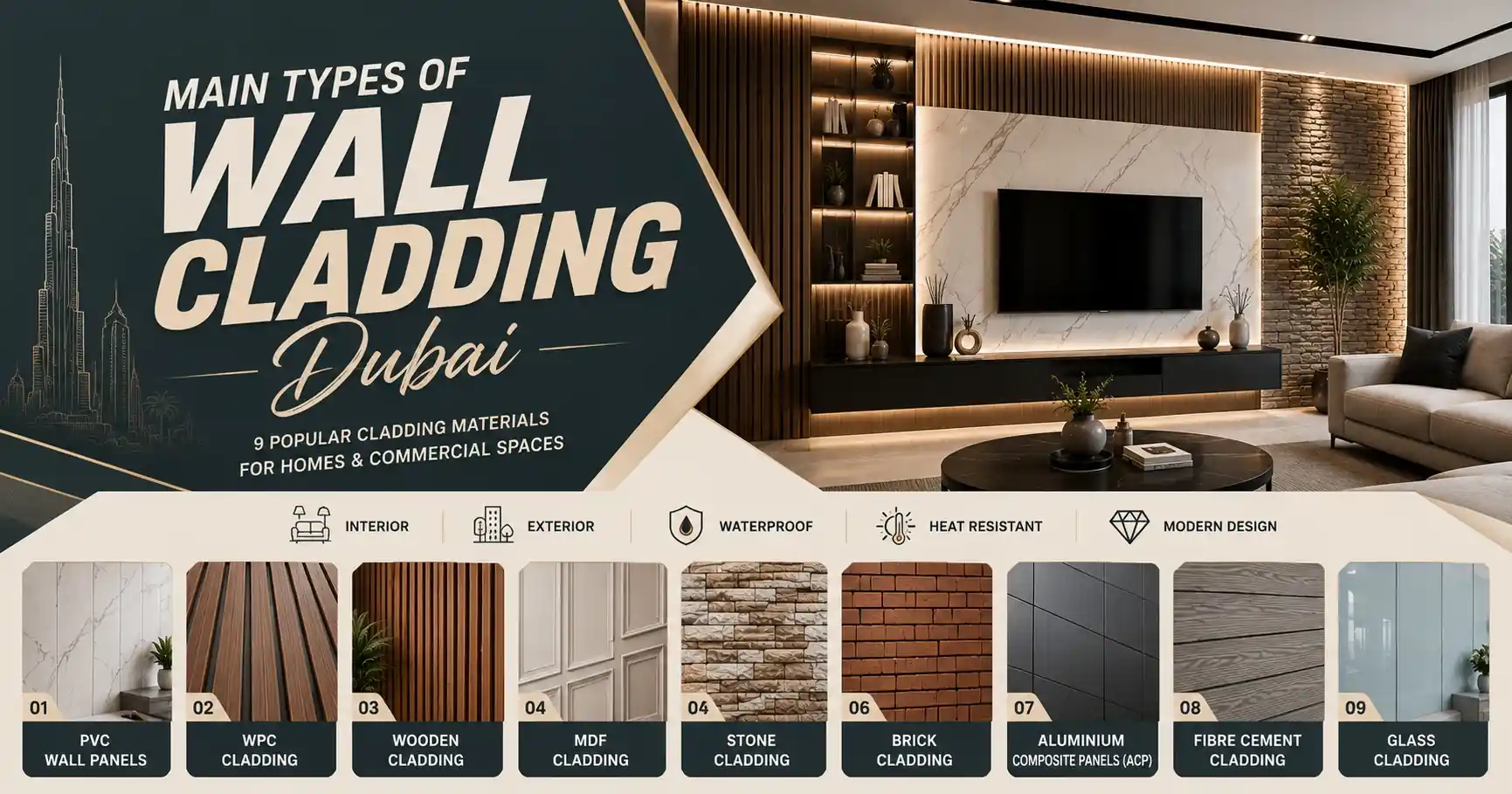
Here are the nine materials you will actually see in the UAE market. Each one has a clear best use.
1. PVC Wall Cladding
PVC is the most practical option for wet rooms. It is fully waterproof. Mould does not grow on it. A wet cloth cleans it in seconds.
PVC wall panels are light and hollow inside. Fitting is quick. Most rooms are finished in a single day. Cost is the lowest in this list, which is why it dominates bathrooms and kitchens in almost every apartment.
The downside is feel. Tap it and you hear the hollow sound. It will never pass for real wood or real stone up close. But from two metres away, modern prints look surprisingly good.
Best for: bathrooms, kitchens, laundry rooms, rented flats, tight budgets. See our full PVC wall cladding range.
2. WPC Cladding
WPC stands for wood plastic composite. Think of it as the middle ground. It carries wood fibre for the warm look and plastic for the water resistance.
It is heavier and stronger than PVC. It handles direct sun without warping. It also handles rain and washing without swelling. That combination makes it the top seller for outdoor use in the UAE. Install WPC over a ventilated frame and it holds its shape right through summer.
The price sits in the middle. Not cheap, not luxury. For most villa boundary walls and balconies, WPC is the sensible answer.
Best for: balconies, terraces, garden walls, pool areas, shaded facades. Browse our outdoor wall cladding options.
3. Wooden Cladding
Nothing beats real timber for warmth. The grain is never repeated. The colour deepens with age. It instantly makes a room feel expensive.
But wood cladding needs care in this climate. Untreated timber outdoors will crack under UV. Indoors it is easy. Outdoors you need a treated or thermally modified species, plus resealing every year or two.
Wooden wall panels come as slats, planks, or wide boards. Solid wood panels cost more than veneered ones, but they sand back to new.
Slat designs are very popular right now. Vertical timber strips over a black backing. Slat wall panels and acoustic wall panels are built the same way. They look sharp and they soften echo in large rooms.
Best for: living rooms, bedrooms, offices, reception areas. Explore wooden wall cladding and wood wall paneling.
4. MDF Cladding
MDF is an engineered board. It is smooth, flat, and easy to shape. That makes it perfect for a walls, beadboard, and classic wainscoting.
It also takes paint beautifully. If you want an exact colour to match your sofa, it gives you that freedom.
One firm rule: keep the board dry. It swells if water reaches the core. Never use it in a bathroom or on an exterior wall. Living rooms and bedrooms only.
Best for: dry interior, painted panelling, headboards, office cabins.
5. Stone Cladding
Stone brings weight and status. Marble, travertine, limestone, slate. Each has its own character. For entrance lobbies and villa facades in Jumeirah, nothing else creates the same impression. It is the classic premium wall finish.
Real stone is heavy, so the wall behind must be strong enough. Installation takes longer and costs more. Many homeowners now choose stone-look composite panels instead. They give the same visual effect at a fraction of the weight and price.
Best for: entrance walls, villa facades, lobbies, TV walls. See our stone wall panels.
6. Brick Cladding
Brick gives a relaxed, industrial mood. Cafes love it. So do modern apartments in Downtown and Business Bay.
Real brick slips are thin cut pieces of clay. Faux brick panels copy the look in PVC or polyurethane and weigh almost nothing. They read far better than brick-effect wallpaper, and the faux version is far easier to fit and much cheaper.
White and grey brick suits a bright minimal room. Red and terracotta suits a warm rustic room.
Best for: accent walls, cafes, retail shops, studios. View our brick wall panels.
7. Aluminium Composite Panels (ACP)
ACP is the standard choice for commercial buildings. Two thin aluminium sheets bonded to a core. Flat, sharp, and very tough.
It resists corrosion, ignores UV, and needs almost no maintenance. Shopfronts, signage walls, and office towers across the emirate use it every day. For any commercial space with a street-facing elevation, it gives a high-quality wall finish that still looks new after ten summers.
One critical point. Only use fire-rated ACP with an A2 or mineral core on any building facade. Fire safety rules in the UAE are strict on this. Always ask your supplier for the certificate. You can check current facade requirements through Dubai Municipality before signing off a commercial project.
Best for: commercial facades, shopfronts, offices, signage walls, columns.
8. Fibre Cement Cladding
Fibre cement is cement mixed with cellulose fibre. The result is a board that does not burn, does not rot, and does not attract termites.
It performs extremely well outdoors. Heat, rain, salty coastal air. None of it bothers fibre cement. Boards come in wood-look, flat, and textured finishes.
It is heavy and needs proper cutting tools. This is not a weekend DIY job. But for a long-lasting exterior, few materials match it.
Best for: villa exteriors, boundary walls, coastal properties, warehouses.
9. Glass Cladding
Back-painted glass creates a clean, seamless surface. No joints. No texture. Just a smooth sheet of colour.
It reflects light, which makes small rooms feel bigger. It is also completely non-porous and easy to clean, so one wipe removes everything.
Costs are high and every piece must be measured exactly. There is no cutting on site. But for a modern kitchen splashback or an office boardroom, the finish is hard to beat.
Best for: kitchen splashbacks, office walls, retail displays, bathroom accents. See our glass wall panels.
Comparing All Nine Materials
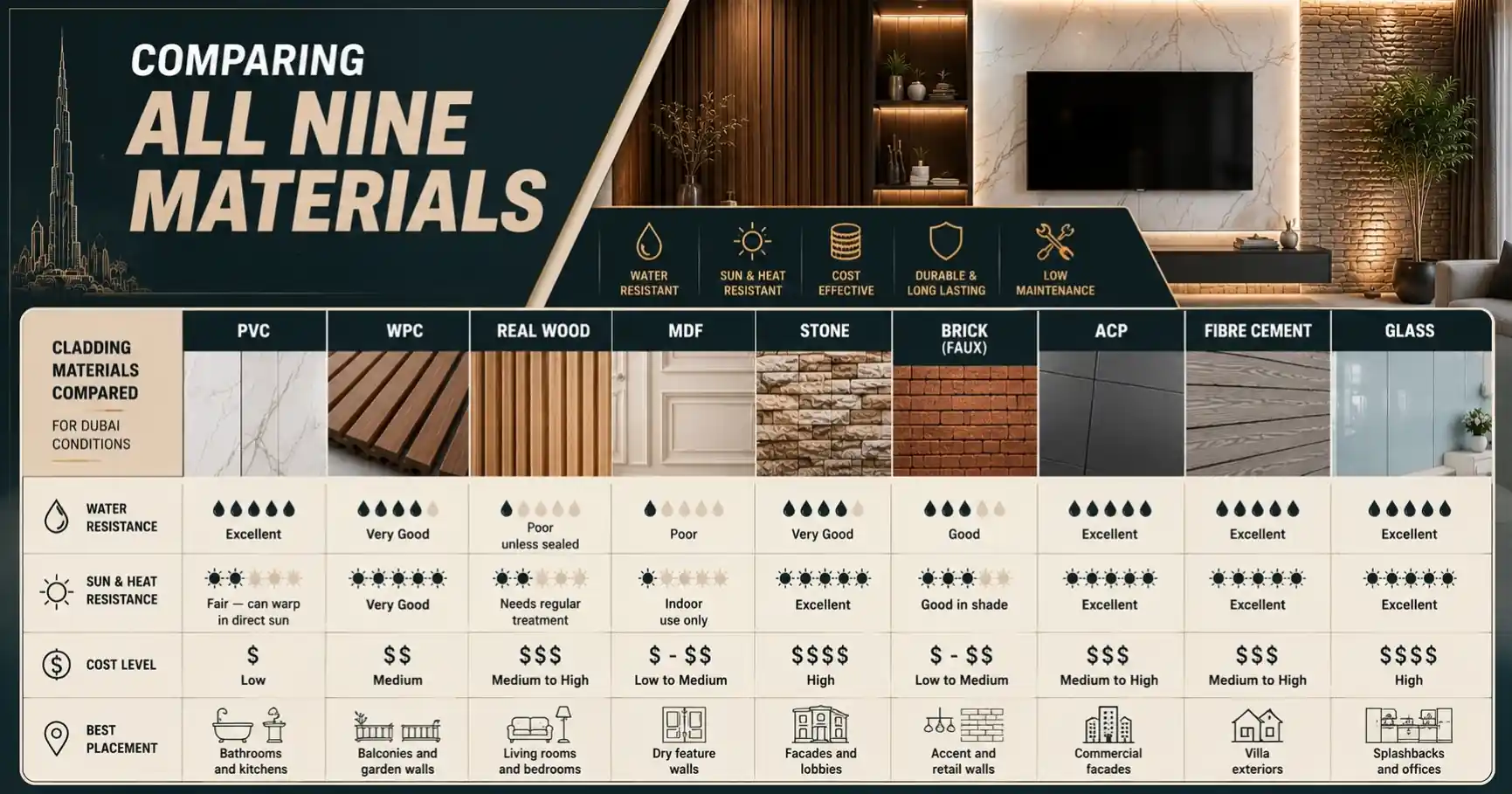
Here is the short version of everything above, side by side.
| Material | Water Resistance | Sun & Heat | Cost Level | Best Placement |
|---|---|---|---|---|
| PVC | Excellent | Fair — can warp in direct sun | Low | Bathrooms and kitchens |
| WPC | Very good | Very good | Medium | Balconies and garden walls |
| Real Wood | Poor unless sealed | Needs regular treatment | Medium to high | Living rooms and bedrooms |
| MDF | Poor | Indoor use only | Low to medium | Dry feature walls |
| Stone | Very good | Excellent | High | Facades and lobbies |
| Brick (faux) | Good | Good in shade | Low to medium | Accent and retail walls |
| ACP | Excellent | Excellent | Medium to high | Commercial facades |
| Fibre Cement | Excellent | Excellent | Medium to high | Villa exteriors |
| Glass | Excellent | Excellent | High | Splashbacks and offices |
Indoor and Outdoor Cladding Are Not the Same
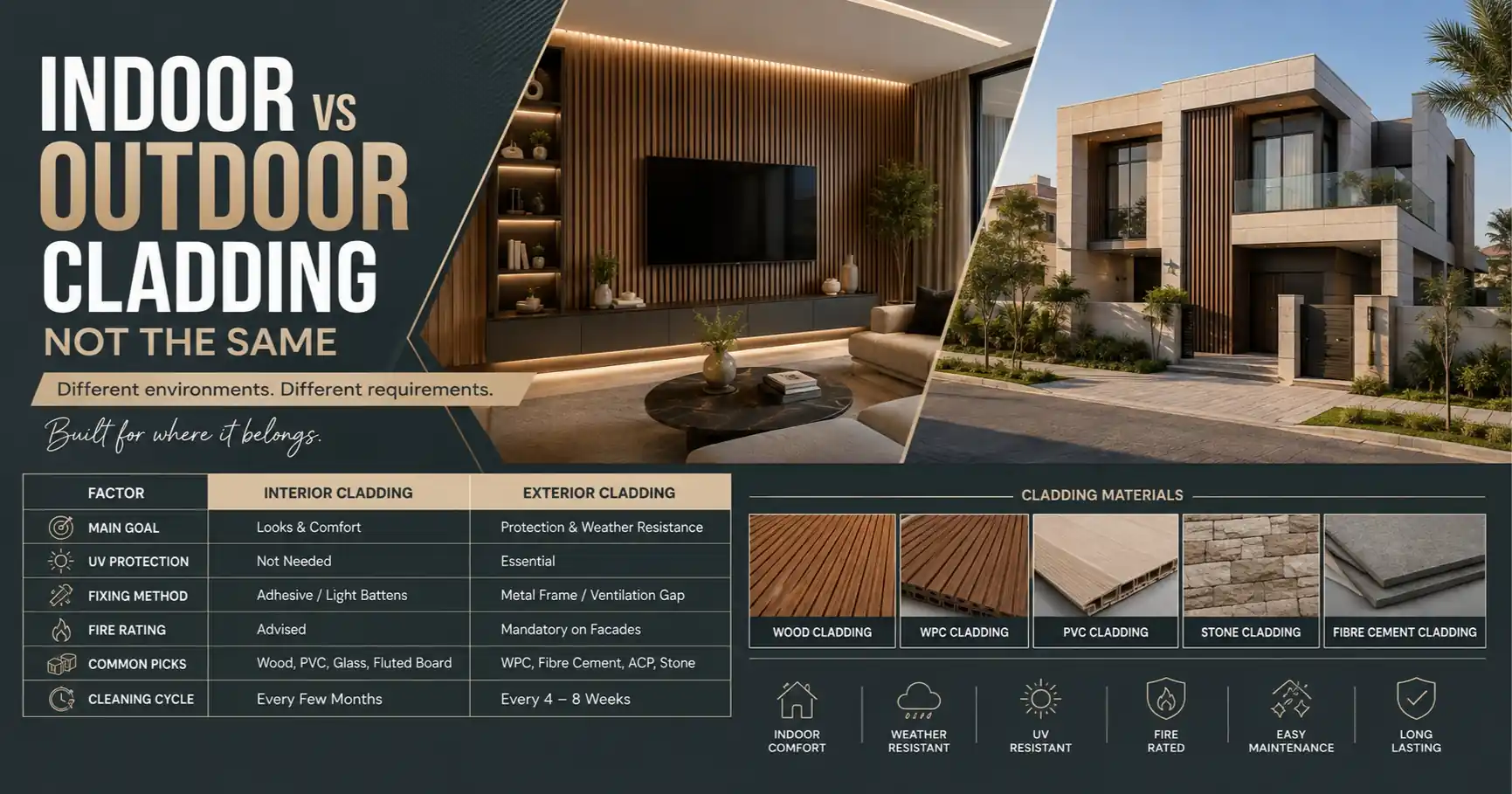
This is where most people go wrong. They see a nice indoor panel and use it outside. Six months later it fades or bends.
Outdoor walls in Dubai deal with UV, heat expansion, humidity, and dust storms. Indoor walls deal with none of that. Interior wall cladding and exterior wall cladding are engineered differently.
| Factor | Interior Cladding | Exterior Cladding |
|---|---|---|
| Main goal | Looks and comfort | Protection and weather resistance |
| UV protection | Not needed | Essential |
| Fixing method | Adhesive or light battens | Metal frame with ventilation gap |
| Fire rating | Advised | Mandatory on facades |
| Common picks | Wood, PVC, glass, fluted board | WPC, fibre cement, ACP, stone |
| Cleaning cycle | Every few months | Every 4 to 8 weeks |
Which Cladding Suits Which Room
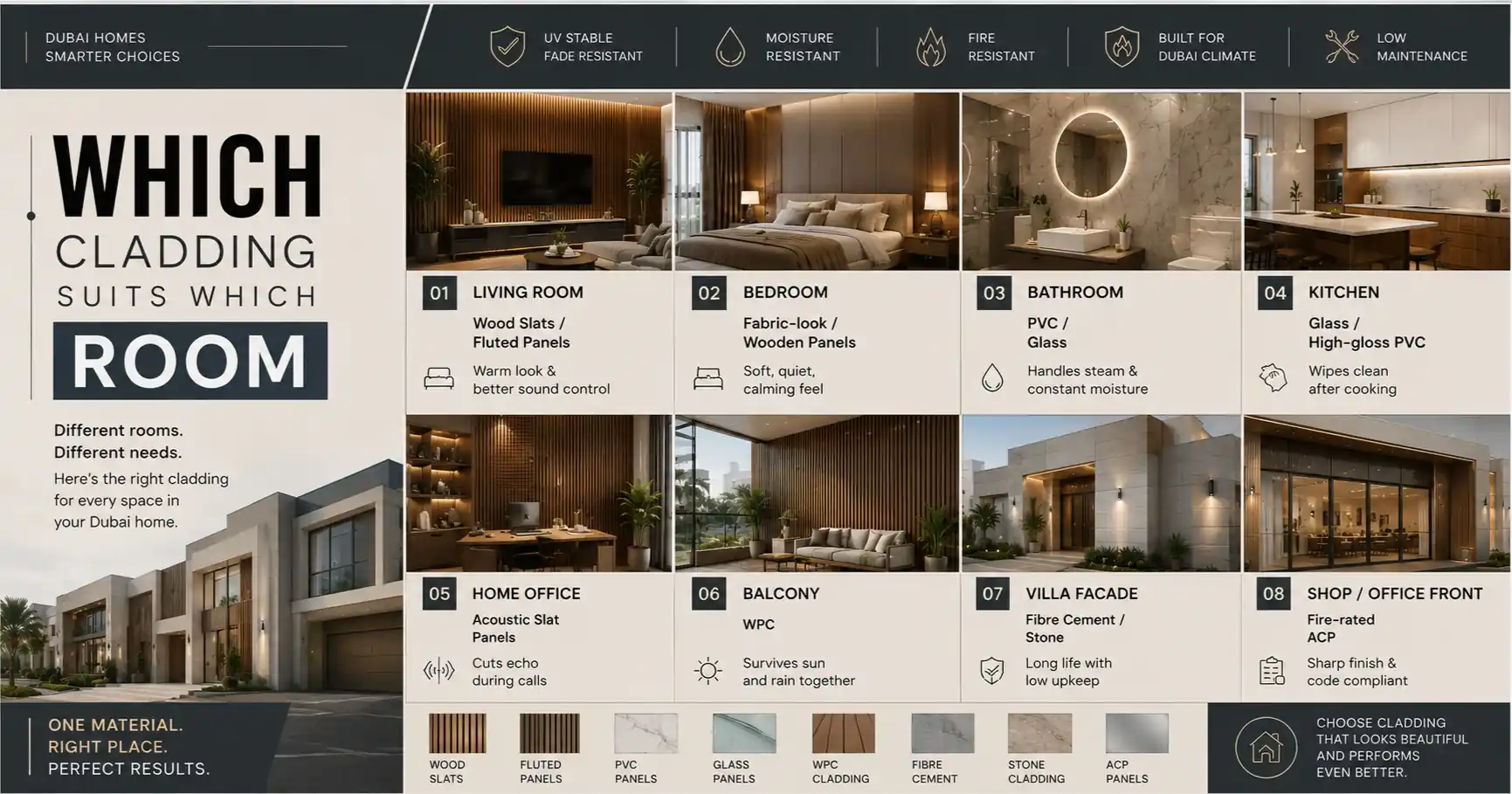
Still unsure? Match the room to the material. All the materials listed below are widely stocked, so availability is rarely an issue.
| Room | Recommended Material | Why It Works |
|---|---|---|
| Living room | Wood slats or fluted panels | Warm look and better sound control |
| Bedroom | Fabric-look or wooden panels | Soft, quiet, calming feel |
| Bathroom | PVC or glass | Handles steam and constant moisture |
| Kitchen | Glass or high-gloss PVC | Wipes clean after cooking |
| Home office | Acoustic slat panels | Cuts echo during calls |
| Balcony | WPC | Survives sun and rain together |
| Villa facade | Fibre cement or stone | Long life with low upkeep |
| Shop or office front | Fire-rated ACP | Sharp finish and code compliant |
For room-specific ideas, visit our pages on living room wall cladding, bedroom wall cladding, and bathroom wall cladding UAE.
Wall cladding designs move fast, so treat the table as a starting point. If a standard size does not fit, a custom wall panel can be cut to your exact opening. Luxury wall panels, 3D wall panels, and plain flat boards all sit on the same frame, so compare panels online first and then order samples before you commit.
How to Choose the Right One
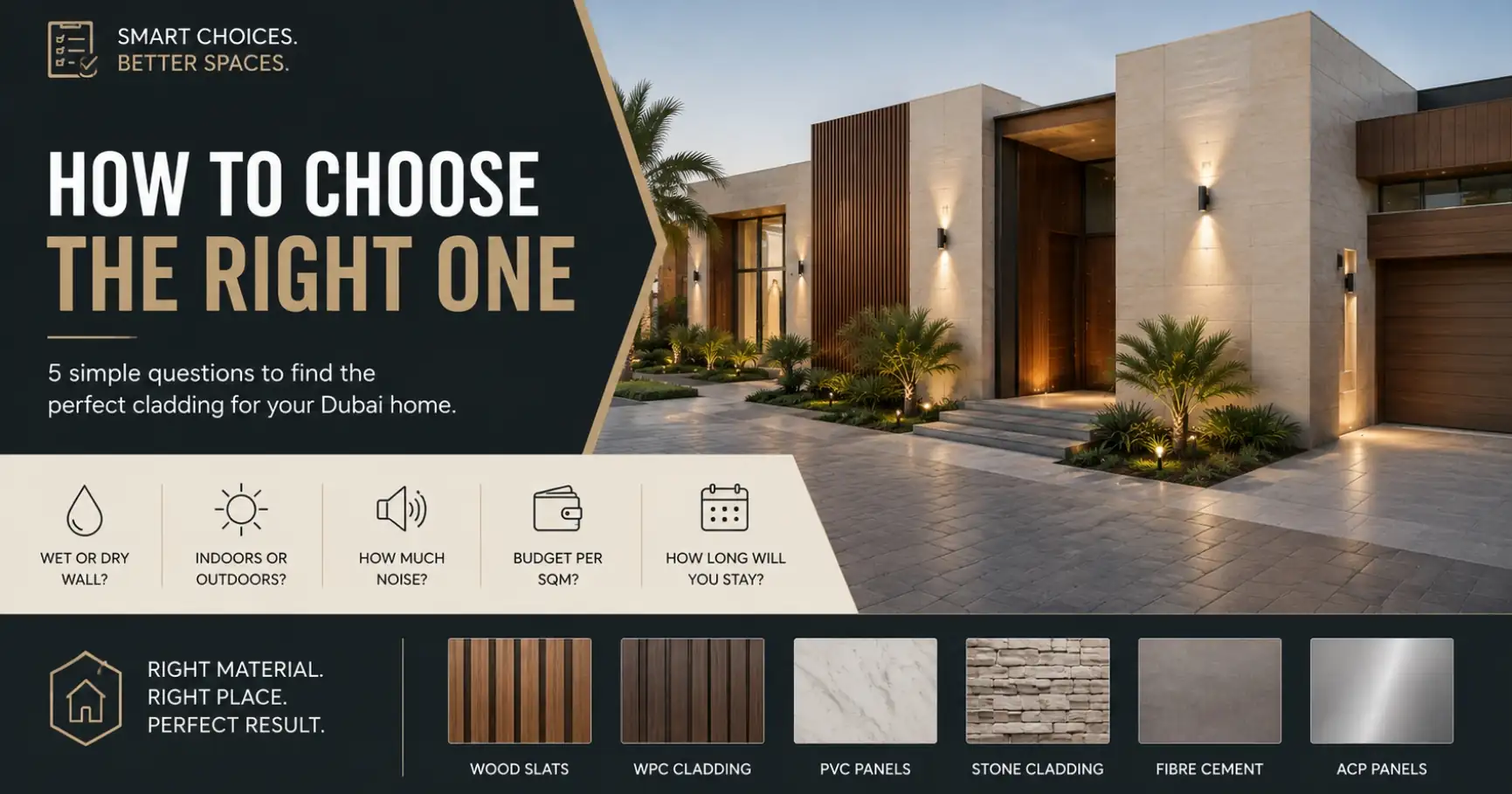
Work through these five questions in order. They narrow the list down fast, and the answer usually appears by question four.
- Is the wall wet or dry? Water changes everything. Wet means PVC, glass, or WPC. Dry opens the full list.
- Is it indoors or outdoors? Direct sun rules out MDF and untreated wood immediately.
- How much noise is there? Big open villas echo. Acoustic slats fix that better than any hard surface.
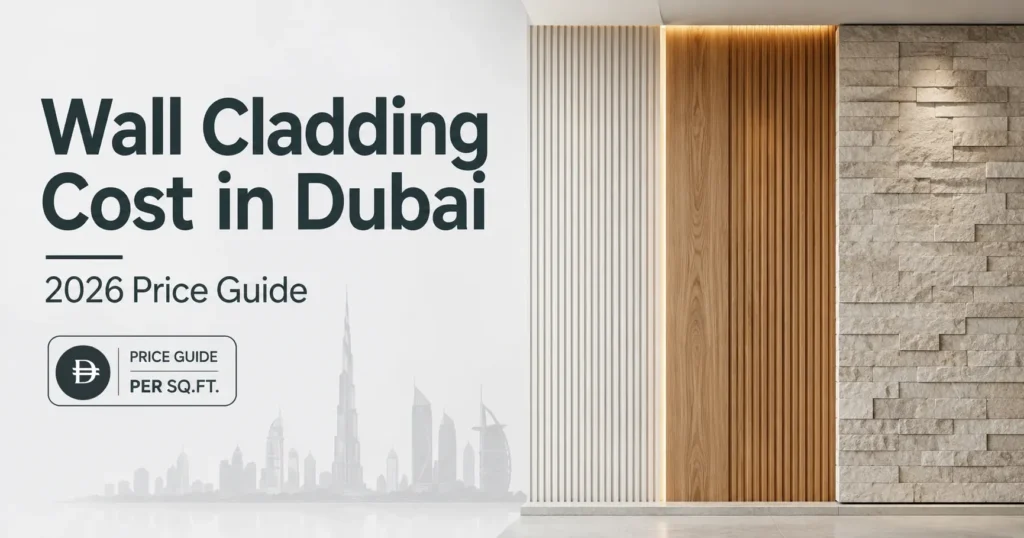
- What is your budget per square metre? Include installation. Material price alone is misleading. Our wall cladding cost guide breaks down real Dubai rates.
- How long will you stay? Renting for two years? Go light and removable. Own the villa? Invest in something that lasts twenty.
One more tip. Always order free samples first. Colours look different under UAE daylight than under showroom lighting. Hold the sample against your actual wall before you commit.
What Happens During Installation
Good fitting matters as much as good material. A premium panel fixed badly still looks cheap. Wall panel installation is not complicated, but it is not guesswork either.
A normal job runs like this:
- Survey. The team measures the wall and checks for damp or loose plaster.
- Preparation. Old paint is scraped. Cracks are filled. The surface is levelled.
- Framing. Outdoor work gets a metal or timber frame with an air gap behind. That gap lets moisture escape.
- Fixing. Panels go up with adhesive, clips, or screws depending on the material. PVC and WPC are easy to install. Stone and fibre cement are not.
- Finishing. Trims, corners, and sealant close every edge.
A single interior wall usually takes one day. A full villa facade can take one to three weeks depending on size and access. Most suppliers include panel installation services in the quote, and a flawless installation always starts with an honest survey.
Keeping Cladding in Good Shape
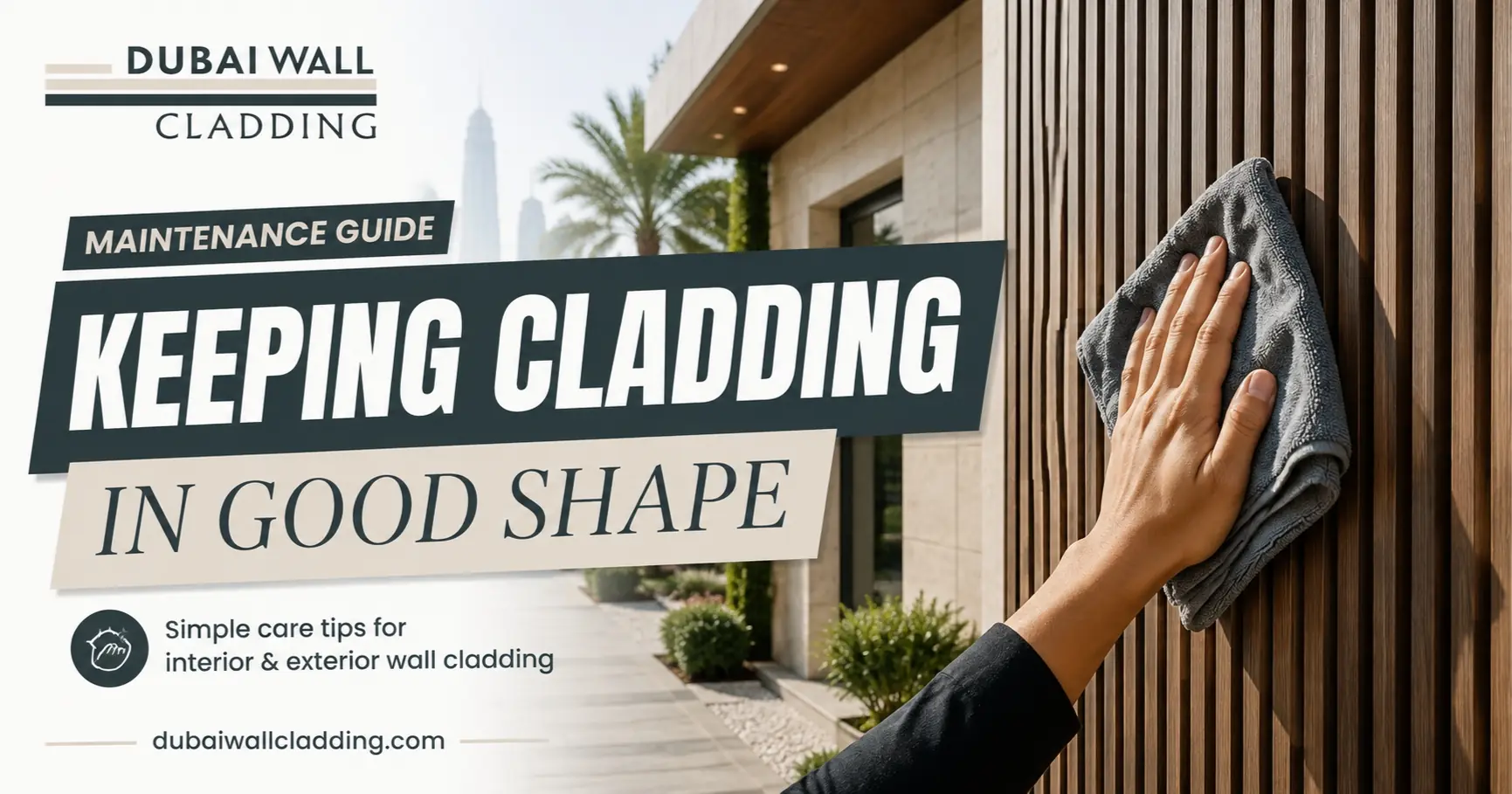
Maintenance here is mostly about dust. Very little else goes wrong if the material was chosen correctly.
- Dust interior panels every two weeks with a dry microfibre cloth.
- Wash exterior surfaces every month or two. Mild soap and water is enough.
- Skip harsh chemicals and steel wool. Both scratch the finish permanently.
- Reseal real timber every twelve to eighteen months outdoors.
- Check joints and sealant once a year, especially after summer.
- Rinse more often if you live near the coast. Salt builds up faster there.
Mistakes That Cost People Money
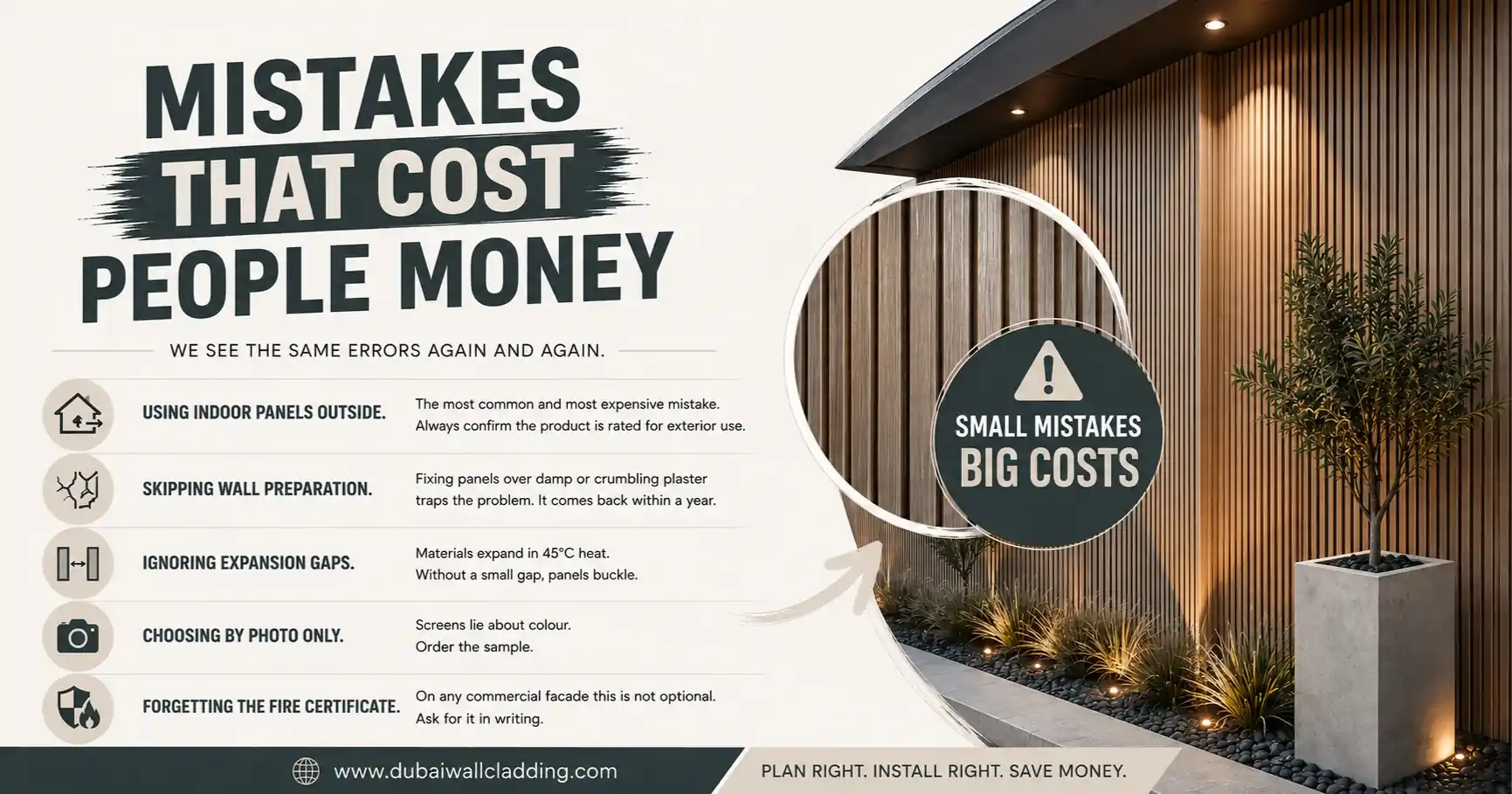
We see the same errors again and again.
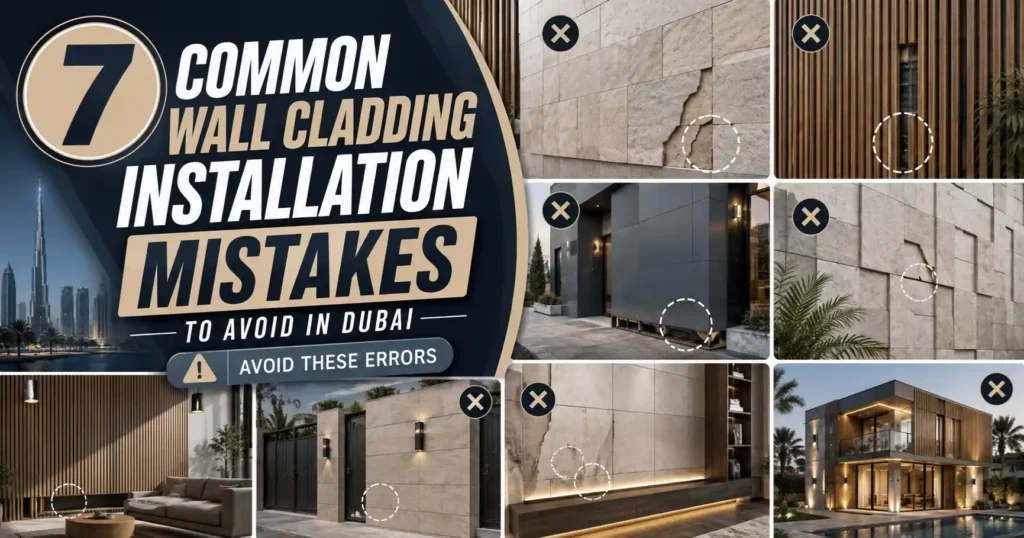
Using indoor panels outside. The most common and most expensive mistake. Always confirm the product is rated for exterior use.
Skipping wall preparation. Fixing panels over damp or crumbling plaster traps the problem. It comes back within a year.
Ignoring expansion gaps. Materials expand in 45°C heat. Without a small gap, panels buckle.
Choosing by photo only. Screens lie about colour. Order the sample.
Forgetting the fire certificate. On any commercial facade this is not optional. Ask for it in writing.
Frequently Asked Questions
Which cladding material lasts longest?
Stone and fibre cement. Both handle heat, humidity, and salt air for decades with basic cleaning.
Can cladding be fitted over existing tiles?
Yes, in most cases. The tiles must be firmly stuck and reasonably level. Loose tiles have to come off first.
Is cladding waterproof?
It depends on the material. PVC, glass, ACP, and fibre cement are waterproof. MDF and untreated wood are not.
Does cladding help reduce noise?
Acoustic panels do. Standard hard cladding does very little unless soft backing is added behind it.
How long does installation take?
One feature wall takes about a day. A complete villa exterior takes one to three weeks.
Can I remove cladding later?
Clip-fixed and batten-fixed systems come off cleanly. Glued panels usually damage the wall surface underneath.
Final Thoughts
There is no single winner among the types of wall cladding. There is only the right match for your wall. PVC wins in the bathroom. WPC wins on the balcony. Wood wins in the living room. Fibre cement wins on the facade.
Start with the conditions your wall faces. Then pick the material that handles them. Looks come after that, and you will still have plenty of choice.
Need help deciding? Our team supplies and installs every material listed above across Dubai and Abu Dhabi, with delivery across the UAE. Browse the collection or contact us for free samples and a quote.