Wall Cladding vs Wall Panels in Dubai | Benefits, Costs and Best Uses Compared
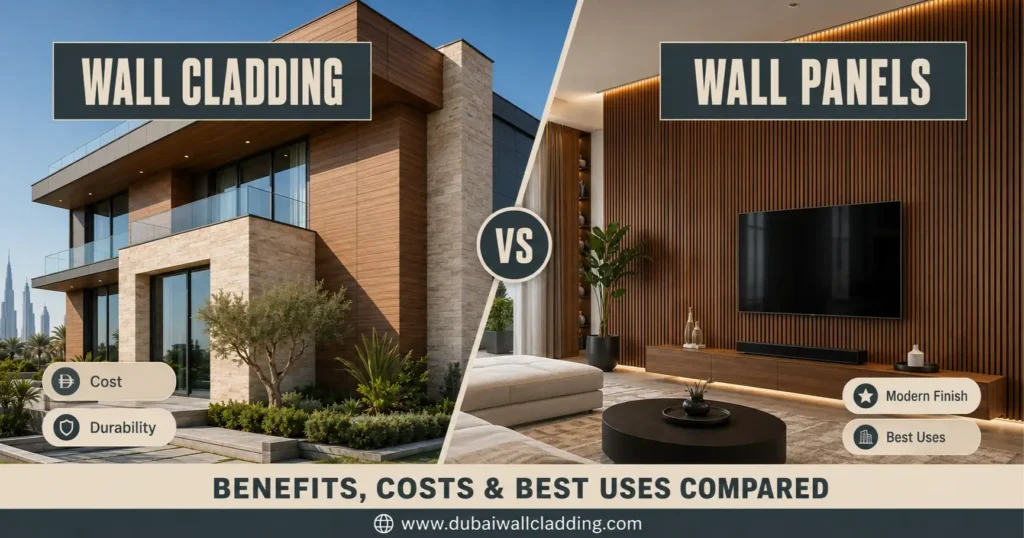
Ask three suppliers about wall cladding vs wall panels in Dubai, and you’ll likely get three different explanations. Half the market treats these terms as interchangeable anyway, so the confusion isn’t really your fault.
Here’s the short version. Cladding is a covering system fastened onto a wall. A panel is a single board or sheet. And a panel can easily form part of a larger cladding assembly — the two concepts blend together far more than most people assume.
This guide untangles the differences between wall cladding and wall panels. The genuine differences, the materials that hold up in Dubai, honest local pricing, how each option copes with the heat here, a note on fire safety, and which finish suits which room. No filler.
A Few Things Worth Knowing First
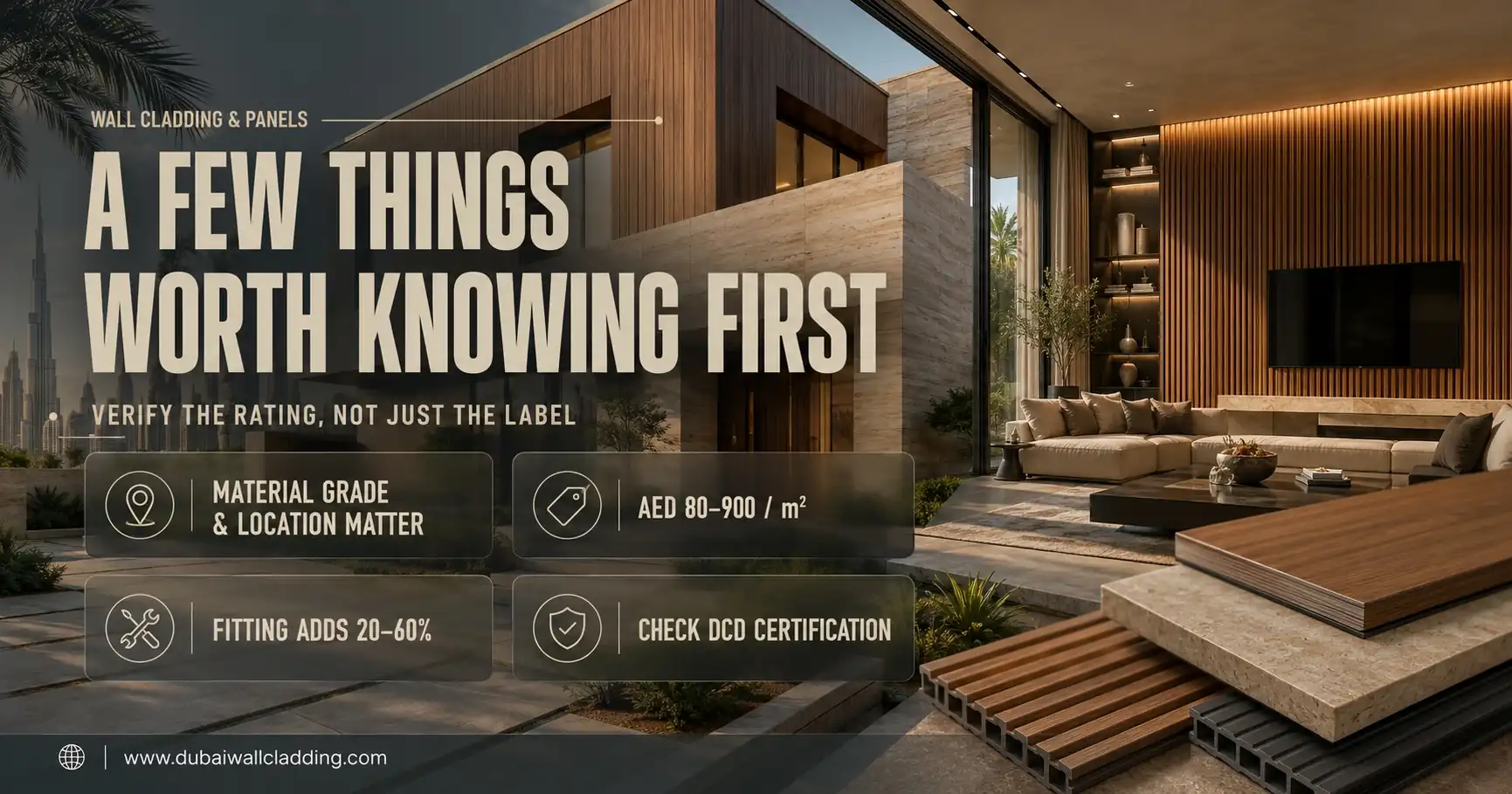
Cladding and panels aren’t two rigid boxes you must choose between. A panel is often just one component of a larger cladding system, so viewing them as competitors doesn’t hold up. What actually matters is the material’s grade and where it’s headed — not the label. Not every interior panel can withstand the Dubai sun, and not every one is fit for a bathroom either. Verify the rating instead of guessing.
Prices typically range from AED 80 to AED 900 per square metre, depending on the product, with fitting usually adding an additional 20 to 60 percent. Anything intended for a facade also has to meet Dubai Civil Defence requirements — a brochure claiming something is “fire-resistant” isn’t the same as a tested certificate.
Wall Cladding vs Wall Panels: Simple Comparison
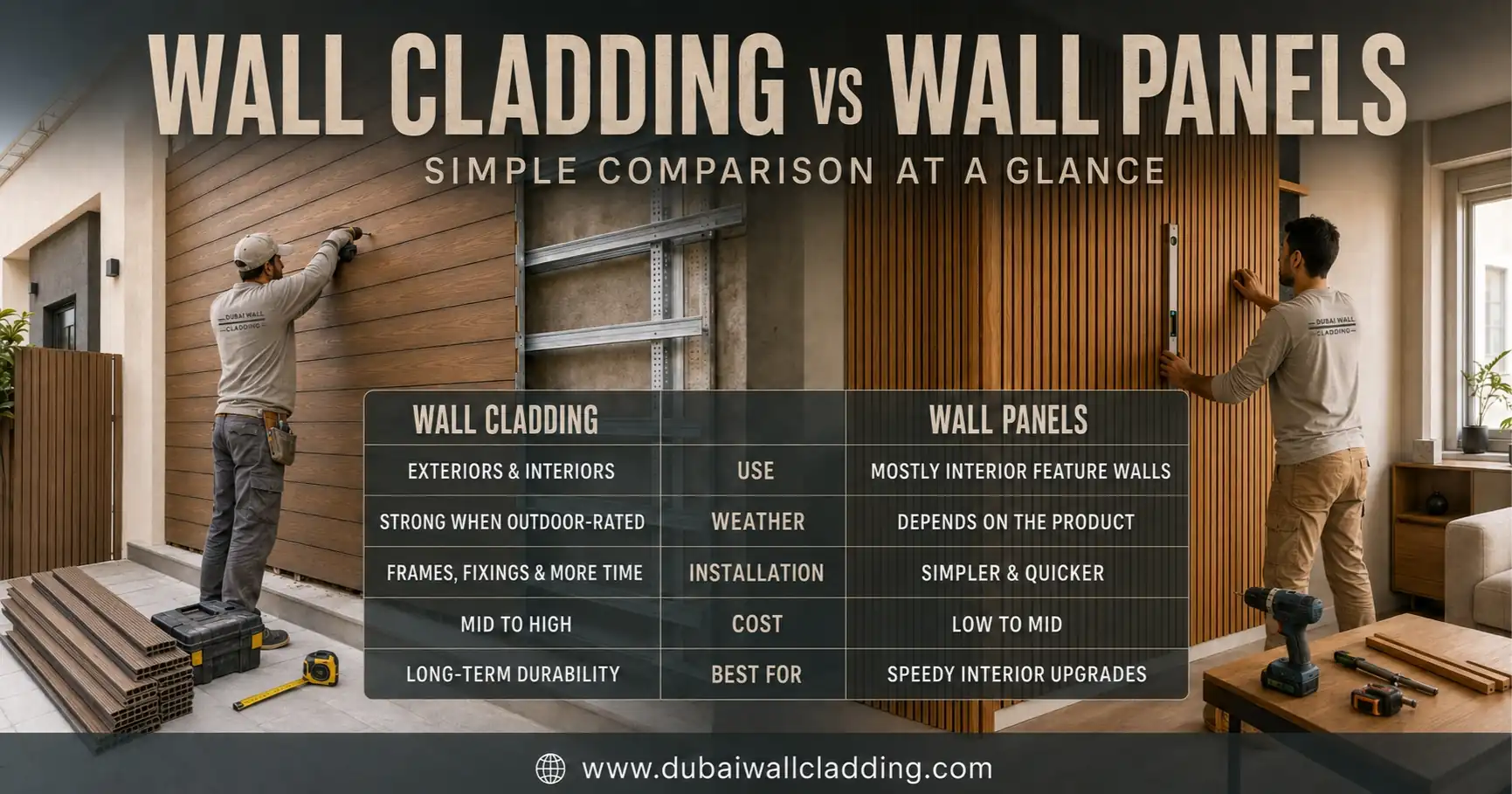
| Point | Wall Cladding | Wall Panels |
|---|---|---|
| Meaning | A covering system fastened onto a wall | A single board or sheet fixed to a wall |
| Main goal | Protection first, appearance second | Appearance first, protection where certified |
| Where used | Building exteriors, boundary walls, and indoors too | Mostly interior feature walls |
| Weather use | Strong when engineered for outdoors | Depends entirely on the specific product |
| Water resistance | Good on exterior-grade systems | PVC and WPC outperform plain MDF here |
| Sound control | Weak unless special backing is added | Can be excellent with acoustic panels |
| Installation | Harder — frames, fixings, more time | Simpler and quicker |
| Cost level | Mid to high | Low to mid, premium for top-tier finishes |
| Best for | Exterior walls, long-term durability | Speedy interior upgrades |
What Is Wall Cladding?
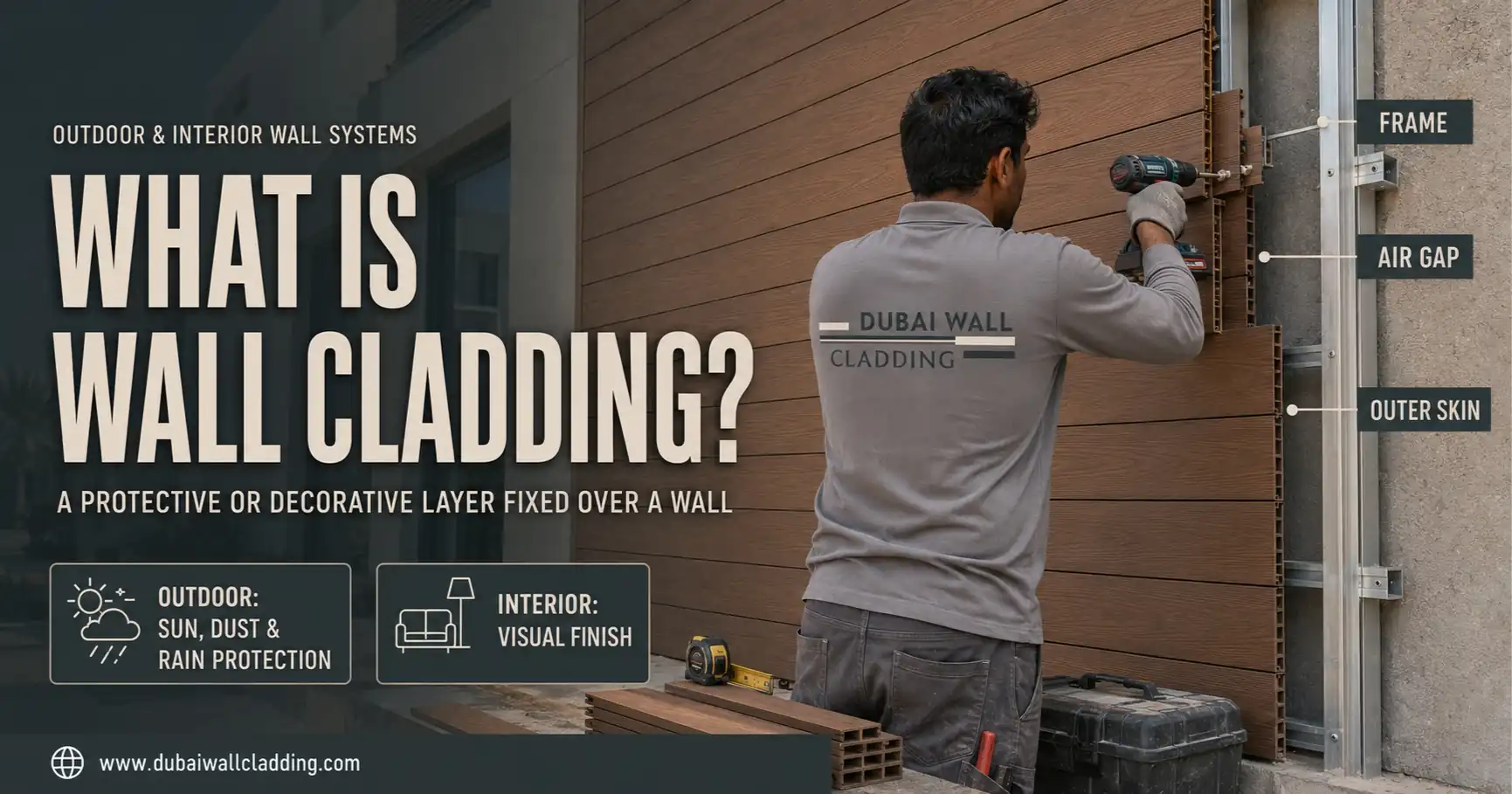
Wall cladding is a layer fixed over a wall. Sometimes that’s it — a single decorative sheet, bonded straight onto the surface. Other times it’s a full assembly: a frame, a slight air gap, and an outer skin secured with brackets. That’s typically what you’d find on a villa exterior.
Outdoor cladding earns its keep here. It absorbs the sun, the dust, the occasional downpour, so the wall behind it doesn’t have to. Interior cladding is a different matter entirely — mostly it exists for visual appeal rather than protection. Browse real examples through wall cladding in Dubai.
What Is a Wall Panel?
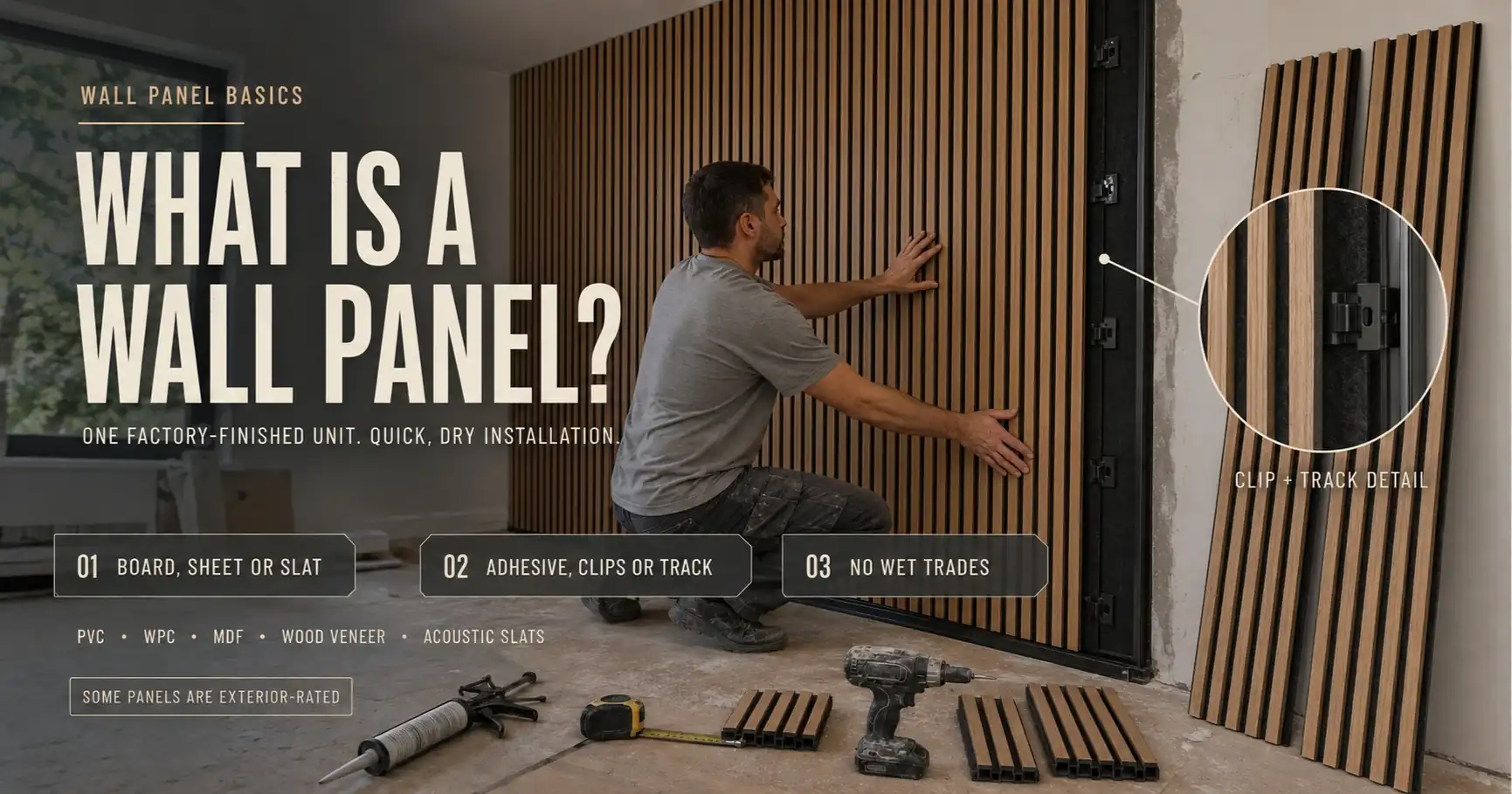
A wall panel is a single unit — a board, sheet, or slat, manufactured and finished before it ever touches your wall. You attach it with adhesive, clips, or a track system. No wet trades. No waiting around for paint to cure. That’s really the whole appeal.
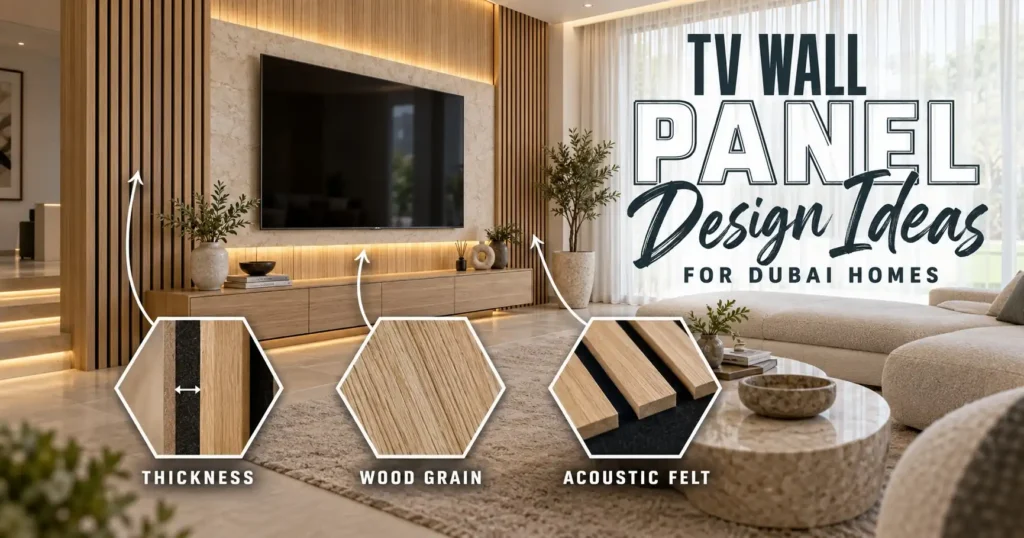
PVC, WPC, MDF, wood veneer, acoustic slats — these dominate the Dubai market for feature walls, TV walls, and office fit-outs. Explore the selection at wall panels in Dubai. Certain panels are engineered for exterior use too — fibre cement, solid aluminium sheets — and once fitted to a building’s front, they perform like cladding, whatever label you attach to them.
Are Cladding and Panels the Same Thing?
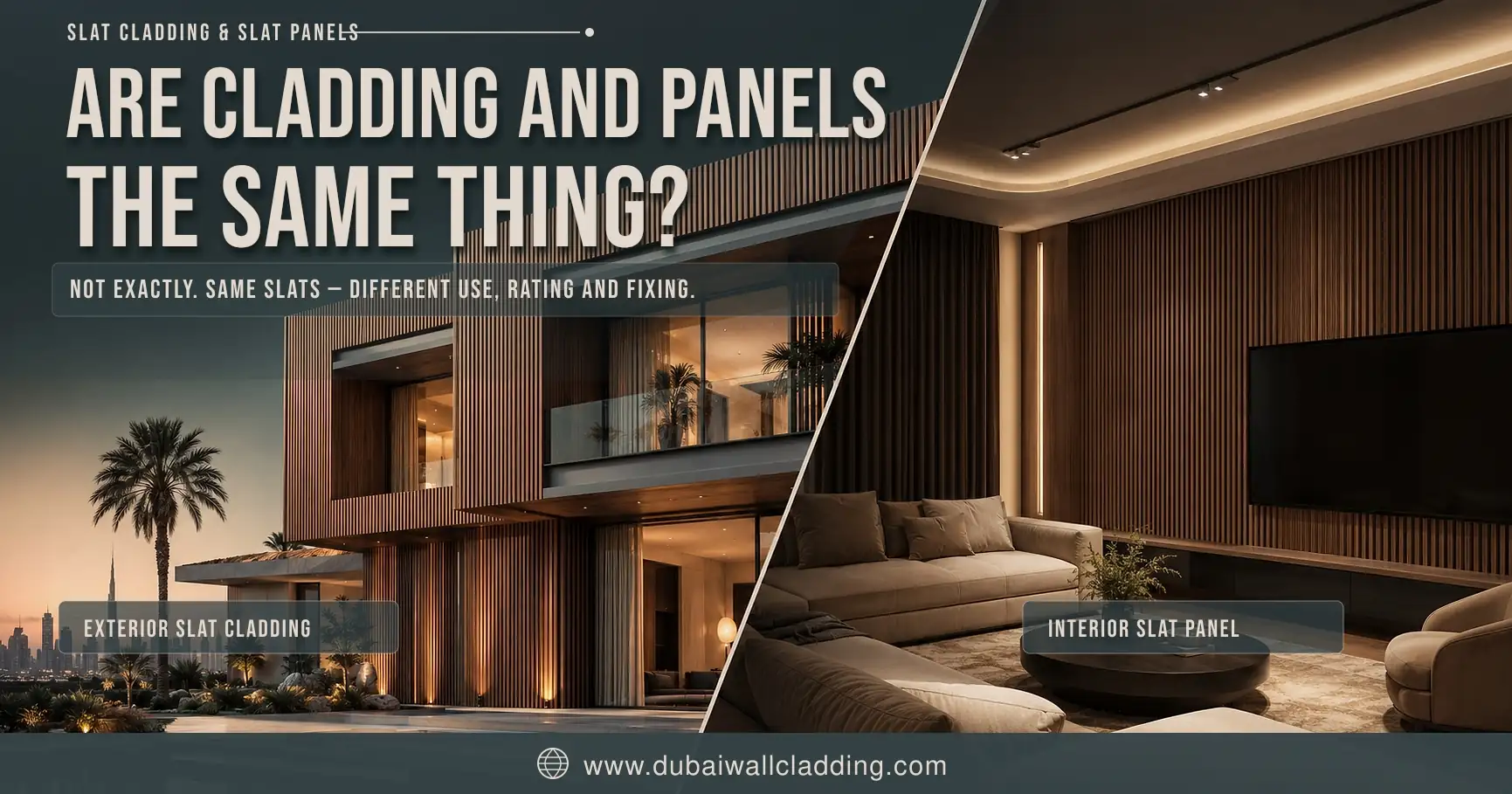
Not exactly. But close enough that debating the terminology is largely pointless. A stone-effect panel bolted into a building’s outer framework? That’s a panel that’s part of a cladding system. A soft MDF panel on a living room wall is simply a panel — nobody’s calling that cladding, even though it technically covers the surface. An acoustic slat panel in a home cinema delivers style and improved sound. Still not cladding.
Outdoor fibre-cement sheets on a facade, though? That’s a cladding system. Each sheet remains, technically, a panel.
So skip the semantic debate. Ask what it’s constructed from, where it’s approved for use, and how it gets fastened. Those three answers reveal more than any label ever could.
Benefits and Limits of Wall Cladding
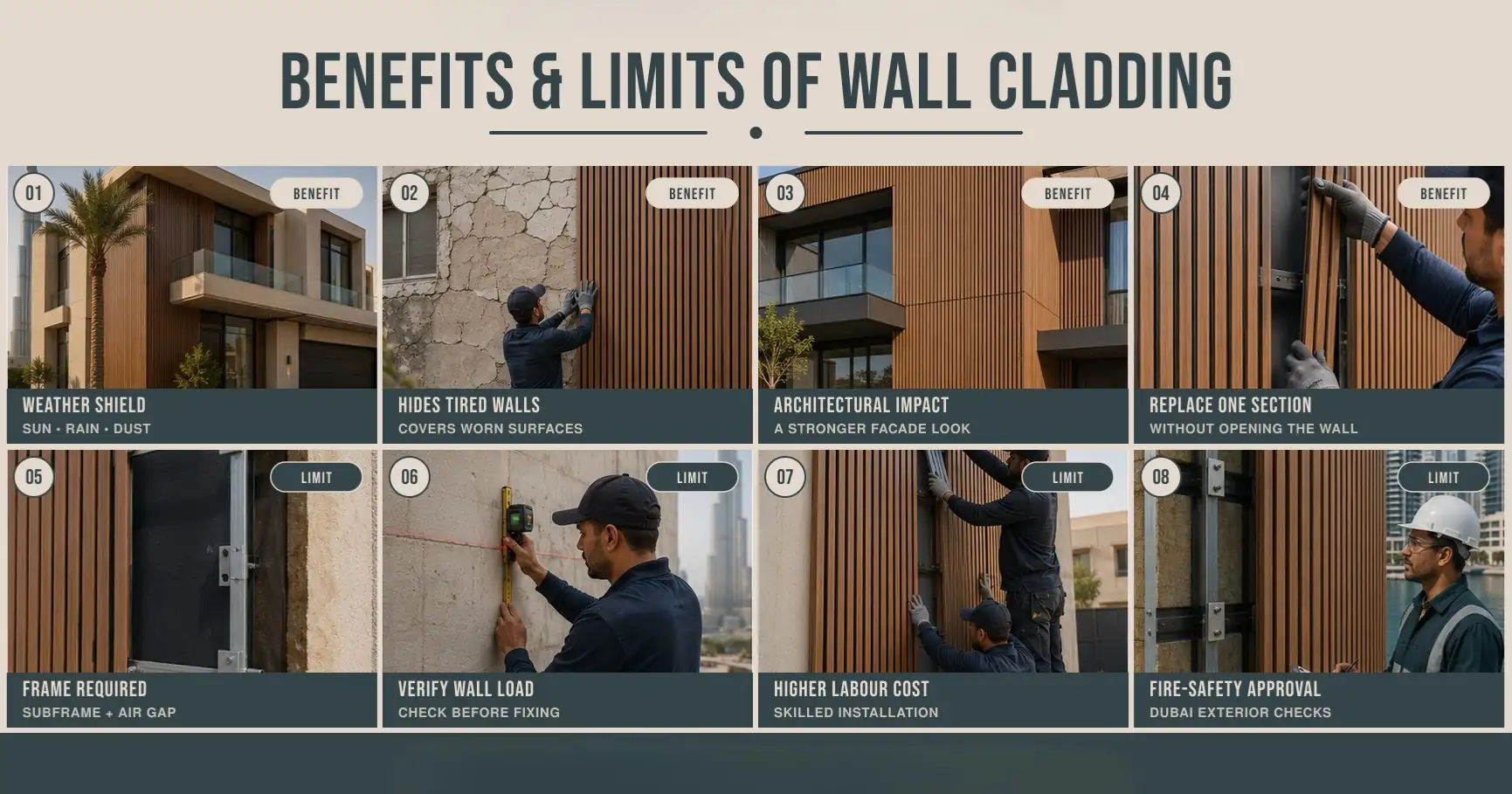
Done well, cladding delivers genuine value. Solid protection against the sun, rain, and dust. It effectively conceals a tired or damaged surface. It lends a building front a real architectural presence. Some systems even allow you to swap out a single damaged section without disturbing the rest of the wall, which counts for more than people realise years down the road.
But it isn’t straightforward. A frame is usually required. Someone needs to verify what the wall can actually bear. Labour costs exceed those for a basic panel job, and anything exterior or on a taller structure must pass Dubai’s fire-safety checks before installation. This isn’t a weekend endeavour. For outdoor projects specifically, explore outdoor wall cladding built for this climate.
Benefits and Limits of Wall Panels
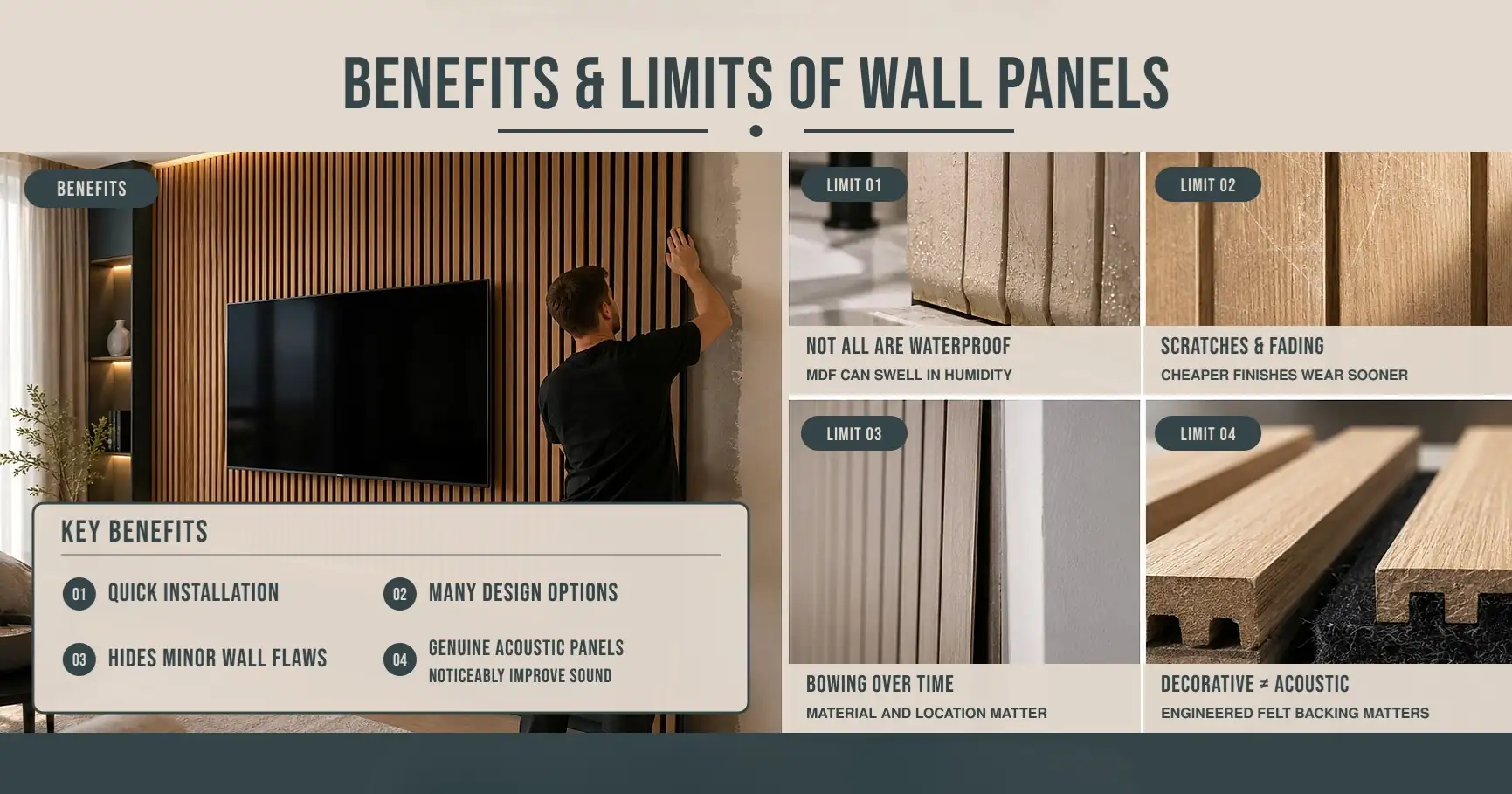
Panels are quick. That’s really the headline benefit. Abundant design options, ideal for feature walls and TV walls, and they’ll disguise minor surface flaws without any plastering. Choose genuine acoustic panels, and a room’s sound quality noticeably shifts — not just its appearance.
Here’s the catch: not every panel is durable or waterproof, so don’t presume a bedroom-grade panel suits a bathroom. Plain MDF and untreated timber can swell in humid air if placed in the wrong location. Cheaper finishes scratch, fade, or bow over time. An ordinary decorative panel won’t dampen sound unless it was specifically engineered for that purpose.
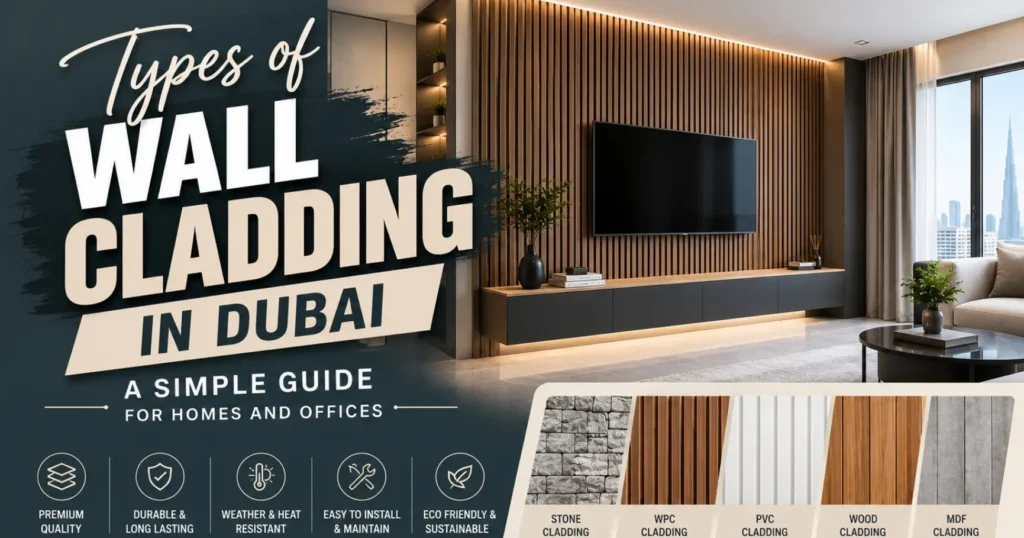
Materials Compared for Dubai Homes and Offices
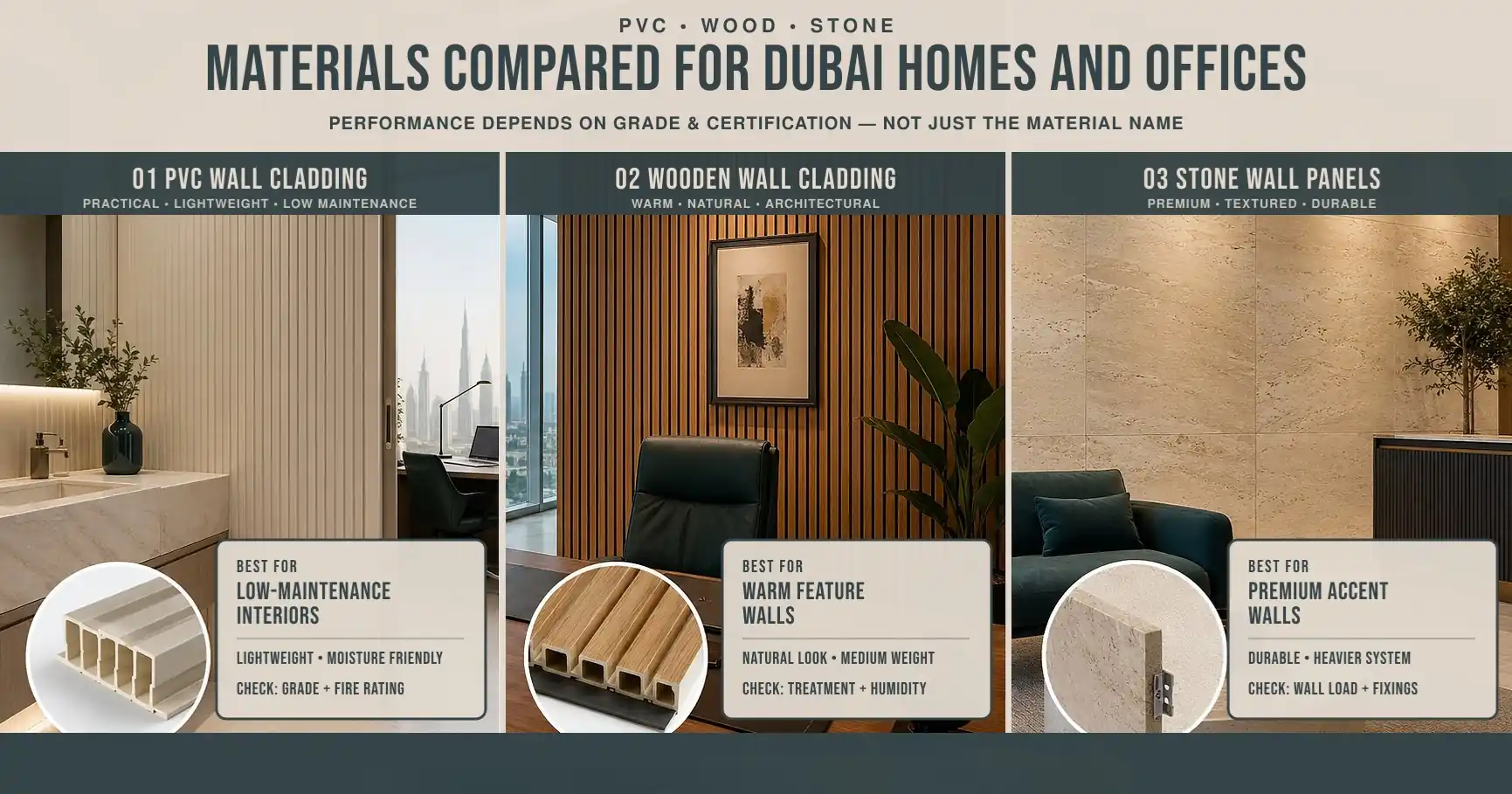
Performance always hinges on the specific product’s grade and certification, not merely the material name. Learn more about PVC wall cladding, wooden wall cladding in Dubai, and stone wall panels if you’d like to dig deeper into any of these options.
Wall Cladding vs Wall Panels: Cost in Dubai
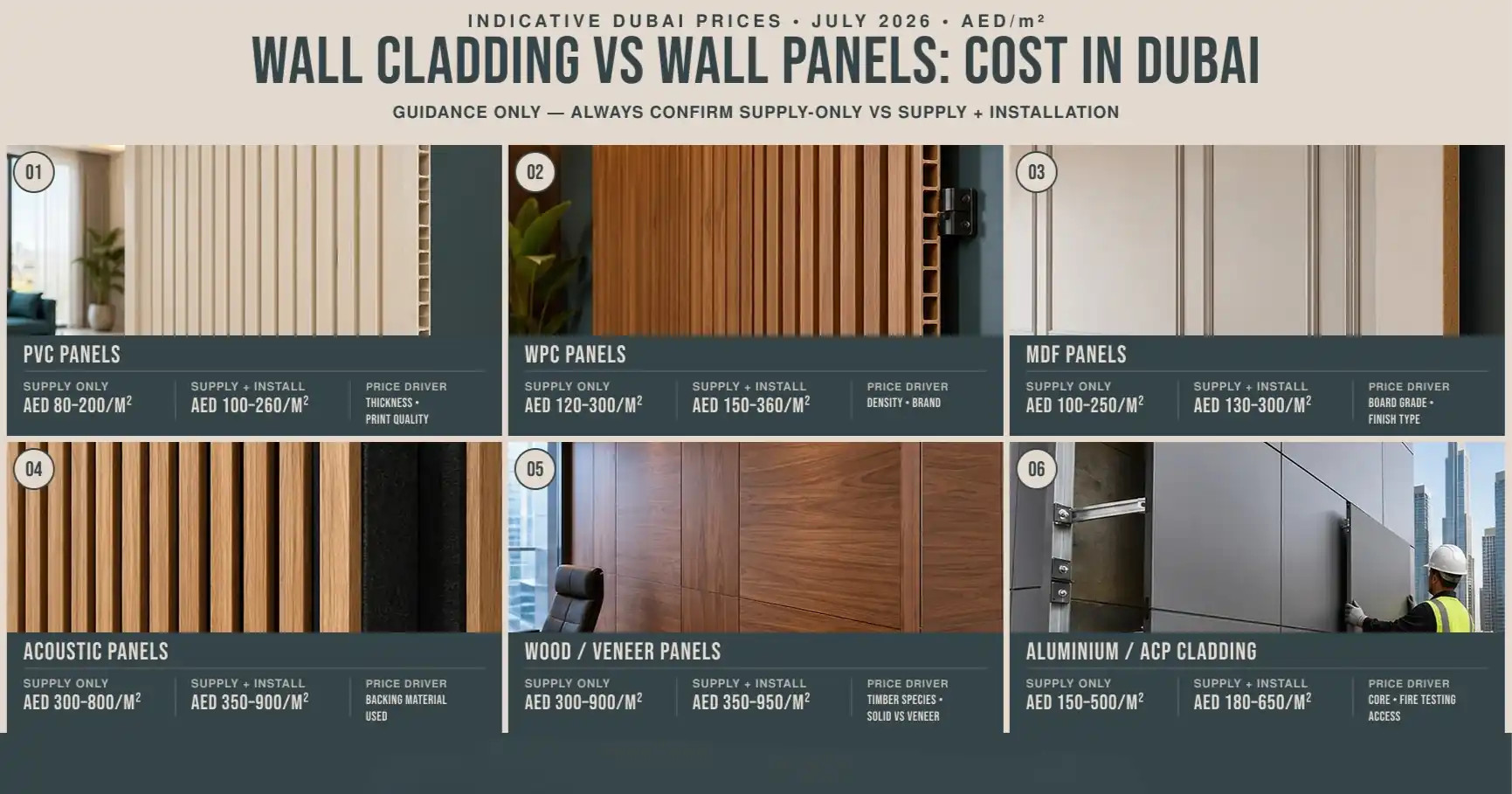
Below are approximate July 2026 market ranges. Guidance, not a formal quotation — treat it accordingly. And always clarify whether a figure is material-only or material-plus-fitting. Confusing the two is probably the number-one way people blow past their budget without understanding why.
| Material | Supply only (AED/m²) | Supply + install (AED/m²) | What shifts the price |
|---|---|---|---|
| PVC panels | 80–200 | 100–260 | Thickness, print quality |
| WPC panels | 120–300 | 150–360 | Density, brand |
| MDF panels | 100–250 | 130–300 | Board grade, finish type |
| Acoustic panels | 300–800 | 350–900 | Backing material used |
| Wood or veneer panels | 300–900 | 350–950 | Timber species, solid vs veneer |
| Aluminium/ACP cladding | 150–500 | 180–650 | Core type, fire testing, access |
1 m² equals roughly 10.764 sq ft. So entry-level PVC at AED 100/m² lands around AED 9–10 per sq ft. Stone and fibre-cement facades are often quoted per slab or per project, since panel dimensions and cutting waste vary widely from site to site. Just avoid comparing a per-piece figure against a per-m² figure. It happens more often than you’d expect.
Quick illustration: a 4m by 2.4m feature wall totals 9.6 m². Factor in a 10% allowance for waste and cuts, and you land at roughly 10.6 m². At an installed WPC rate of AED 250/m², that comes to about AED 2,650 — before VAT, before stripping the existing finish, before any bespoke trims. Your actual figure will shift depending on the wall itself.
Several other variables influence the final price too: wall condition, product thickness, whether it’s interior or exterior, subframe requirements, the number of corners and sockets to navigate, custom colours, removing an old finish, and whether fire-rated or exterior-certified material is needed. For a fuller breakdown, there’s the complete wall cladding cost guide for Dubai.
Which One Handles Dubai’s Weather Better?
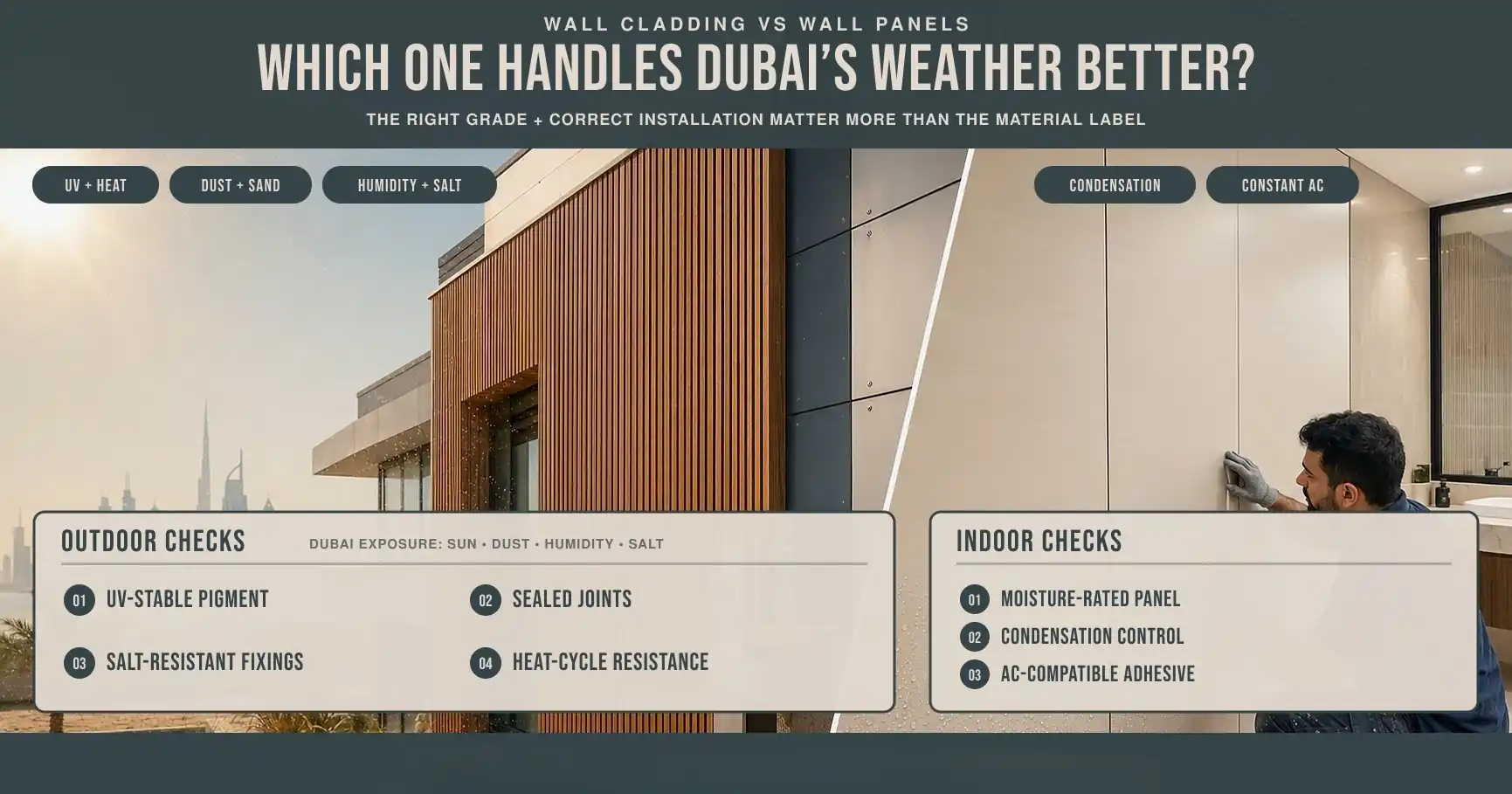
Dubai is genuinely harsh on wall finishes. Intense sun for most of the year. Serious heat in summer. Humidity that spikes near the coastline. Dust, fine sand, and that constant push-pull between chilled indoor air-con and scorching outdoor air, which quietly strains adhesives and joints over time.
For anything outdoors, UV-stable pigmentation matters more than the base material itself. A poorly stabilised product will fade regardless of whether it’s PVC, WPC, timber, or metal — the material name alone won’t save it. Coastal properties should also weigh salt exposure, which accelerates corrosion on untreated metal fittings. Indoors, the bigger issue is usually condensation in bathrooms and kitchens, plus how the adhesive copes under constant air-conditioning.
Nothing here is automatically weatherproof simply because of its label. Grade and correct installation determine whether it’s bathroom wall cladding or a full building exterior.
Fire Safety: Keep This in Mind
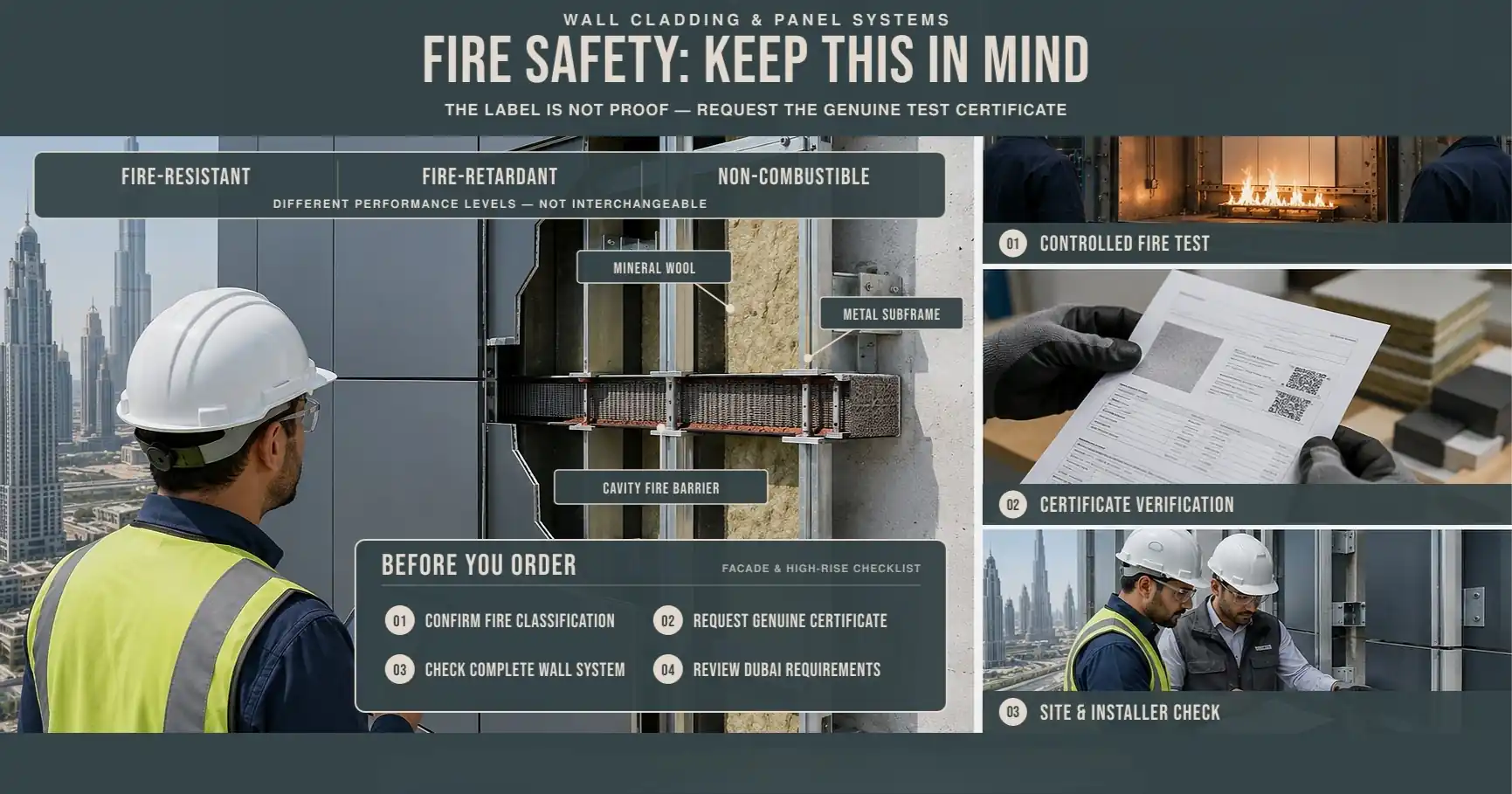
Fire-resistant, fire-retardant, non-combustible — these describe different performance levels, not interchangeable marketing terms, and none should be trusted purely because it appears in a brochure. Request the genuine test certificate before ordering anything for a facade or high-rise project. Always.
The UAE Fire and Life Safety Code, issued by Dubai Civil Defence, establishes specific requirements for exterior wall systems. Suppliers and installers handling these projects generally need Civil Defence registration as well. Interior jobs carry less risk, but confirming fire classification remains sound practice regardless. It’s also worth reviewing the current Dubai Municipality building circulars relevant to your specific project.
Best Choice for Each Room or Space
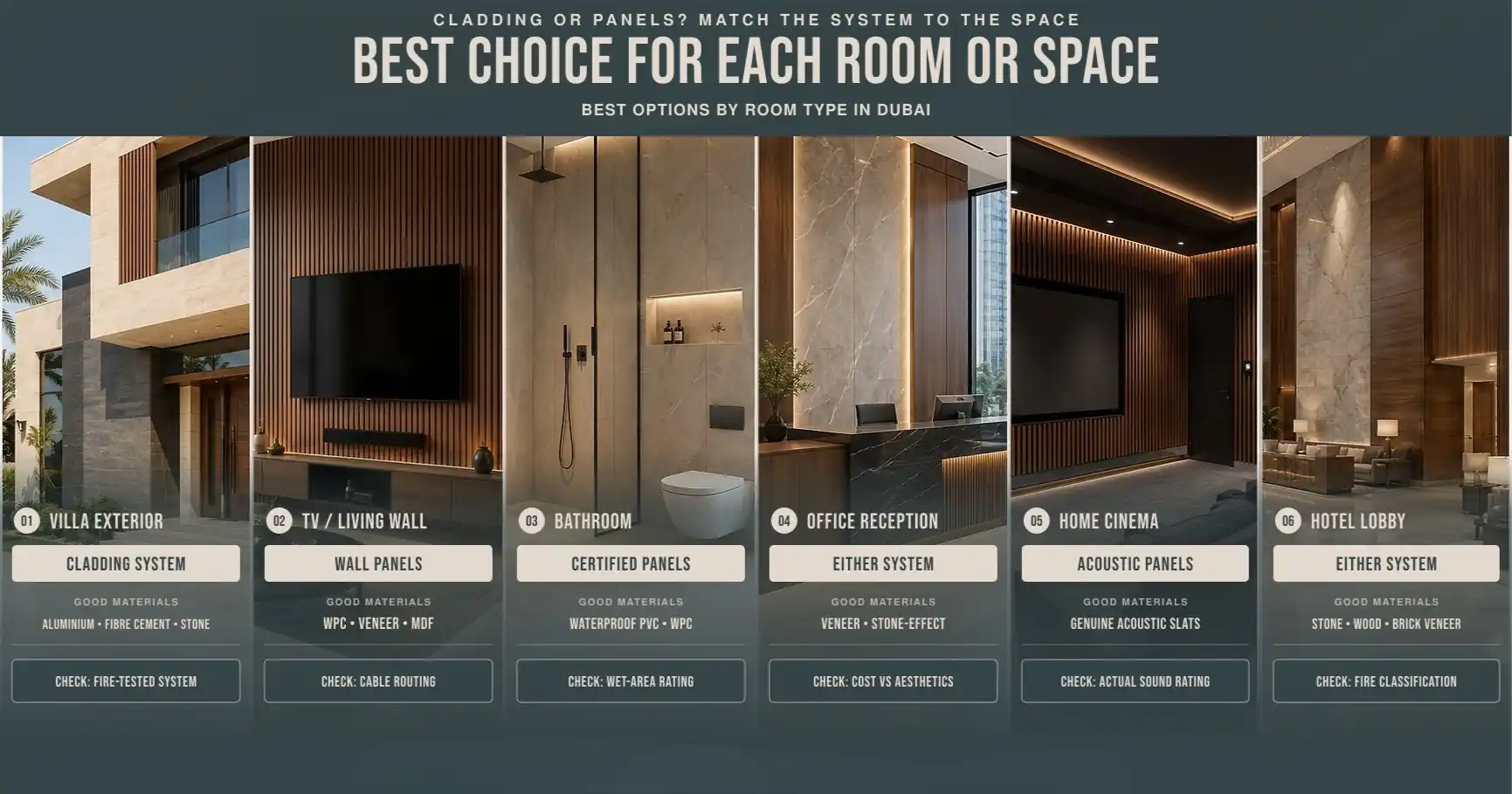
| Space | Better choice | Good materials | Be careful of |
|---|---|---|---|
| Villa exterior | Cladding system | Aluminium, fibre cement, stone | Must be fire-tested |
| Boundary wall | Cladding | Stone, fibre cement | Confirm UV stability |
| Living room wall | Panels | WPC, veneer, MDF | Check with landlord if renting |
| TV wall | Panels | Slat or fluted panels | Plan cable routing beforehand |
| Bedroom wall | Panels | Veneer, MDF | Keep away from humidifiers |
| Bathroom | Certified panels | Waterproof PVC or WPC | Confirm it’s genuinely wet-area rated |
| Office reception | Either | Veneer, stone-effect | Balance cost against aesthetics |
| Meeting room or home cinema | Panels | Acoustic slats | Verify the actual sound rating, not just appearance |
| Hotel lobby or restaurant | Either | Stone, wood, brick veneer | Public areas may require fire classification |
For most interiors, both living room wall cladding and bedroom wall cladding lean toward panelling. Speed and aesthetics simply outweigh weatherproofing in these rooms.
How to Choose
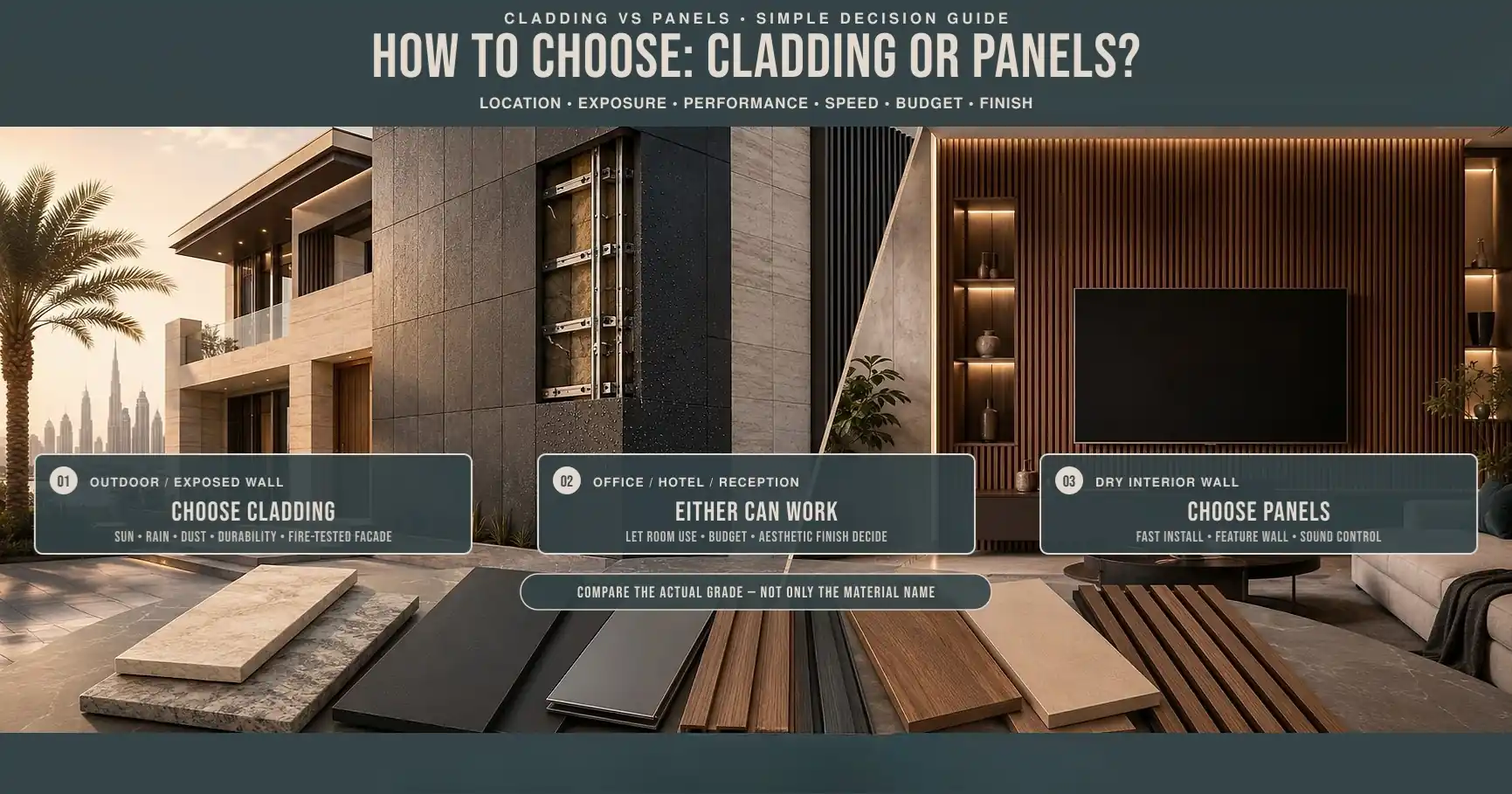
Cladding makes sense when a wall confronts sun, rain, or dust directly, when durability matters more than a fast turnaround, or when fire-tested facade material is genuinely required. Panels suit dry interior walls better, situations demanding speed, or goals like sound control in a media room. For shared spaces — an office reception, a hotel lobby — either approach can genuinely work. It usually comes down to budget and the aesthetic you’re chasing.
How Installation Works
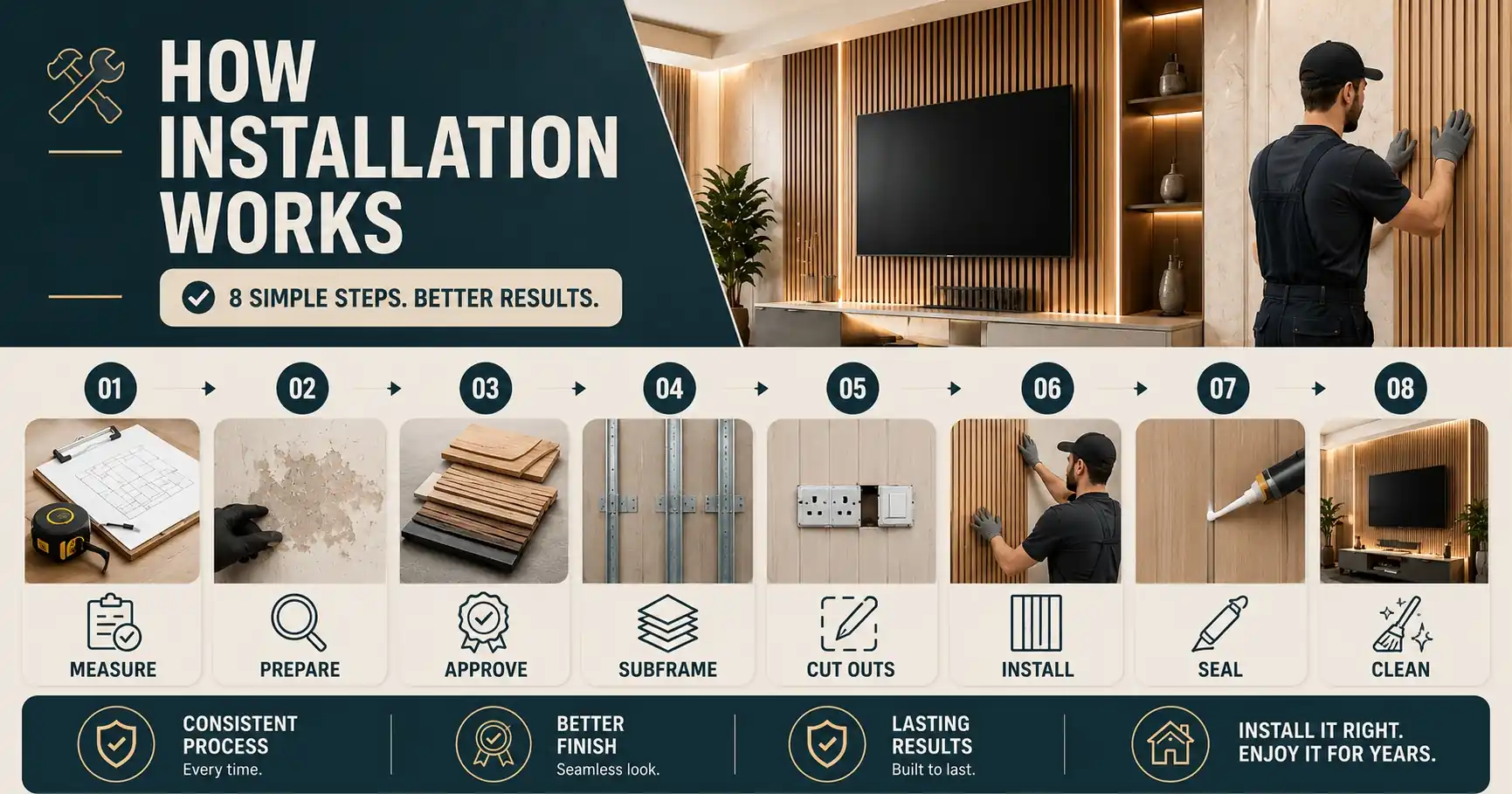
The sequence stays fairly consistent across jobs. Site survey, measurements. A check for dampness or damage. Sample approval. Wall preparation, including stripping any existing finish. Then a subframe or adhesive, depending on the product chosen. Cuts around switches and sockets. The panel or cladding goes up. Trims and joints get sealed. The site gets cleaned. Finished.
A simple interior panel job on a flat, dry wall? A confident homeowner could probably manage it. Exterior cladding, wet zones, anything requiring fire certification — leave those to a trained installer. The risk of getting it wrong simply isn’t worth it.
Maintenance and How Long These Finishes Last
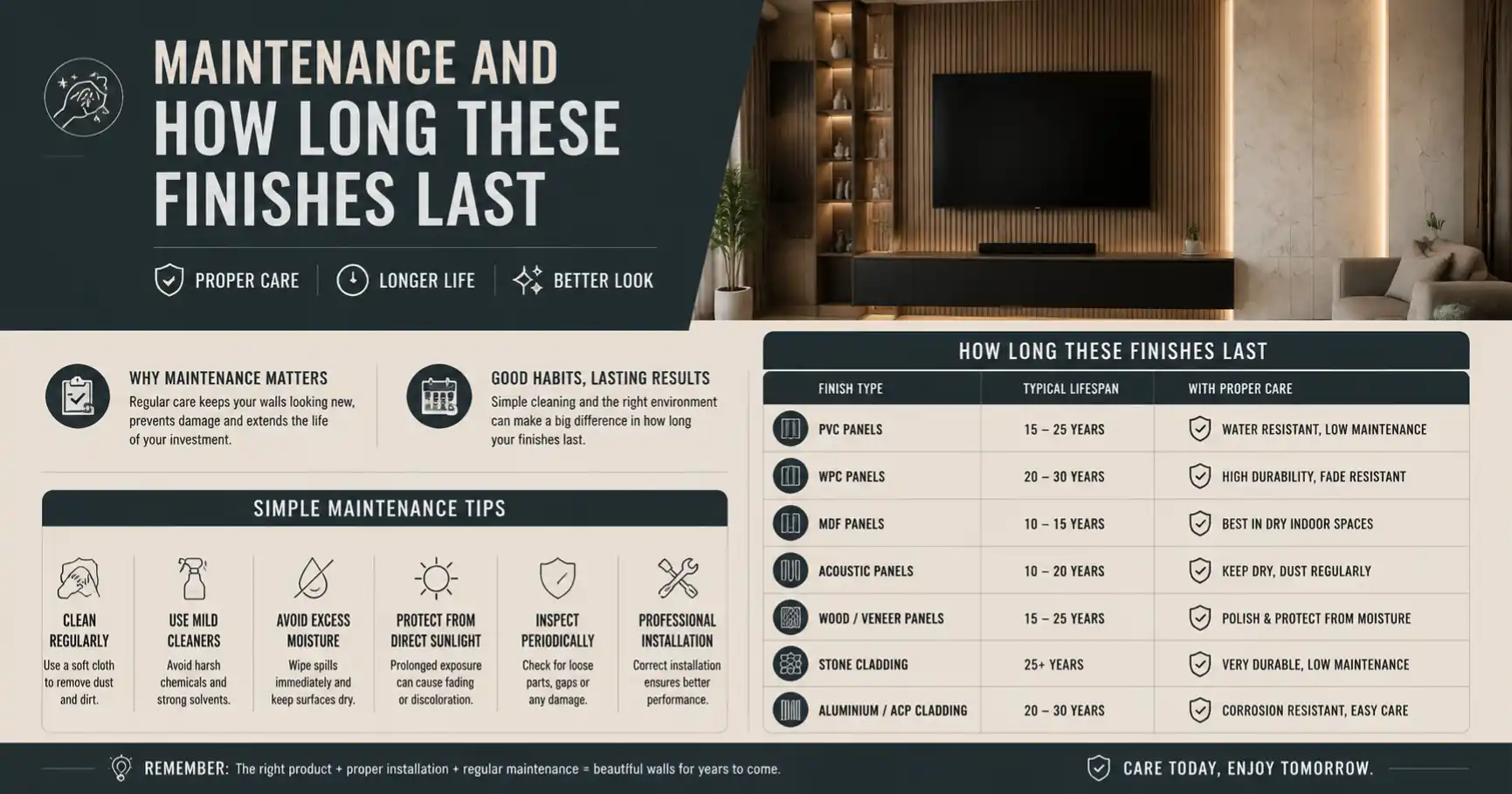
Upkeep depends on the material, not the category. PVC and laminate generally just need wiping down. Wood and veneer might require occasional resealing. Exterior joints and seals are worth inspecting periodically — sun and heat degrade those faster than the panel itself.
There’s no universal lifespan, and anyone claiming otherwise is guessing. It comes down to grade, interior versus exterior exposure, sun intensity, humidity, installation quality, cleaning habits, and the manufacturer’s actual warranty. Secure that warranty in writing. Don’t rely on a verbal assurance.
Common Mistakes to Avoid
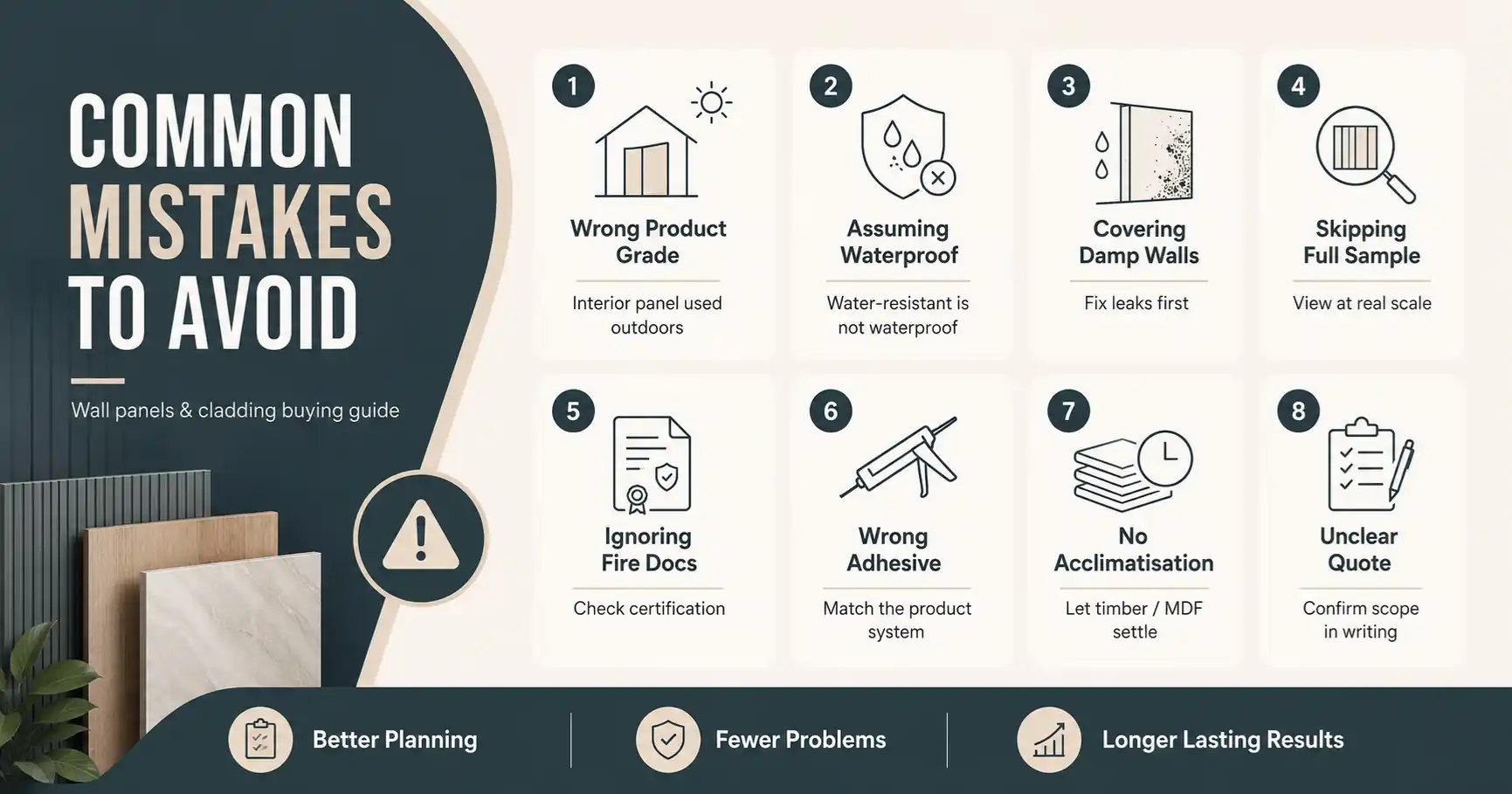
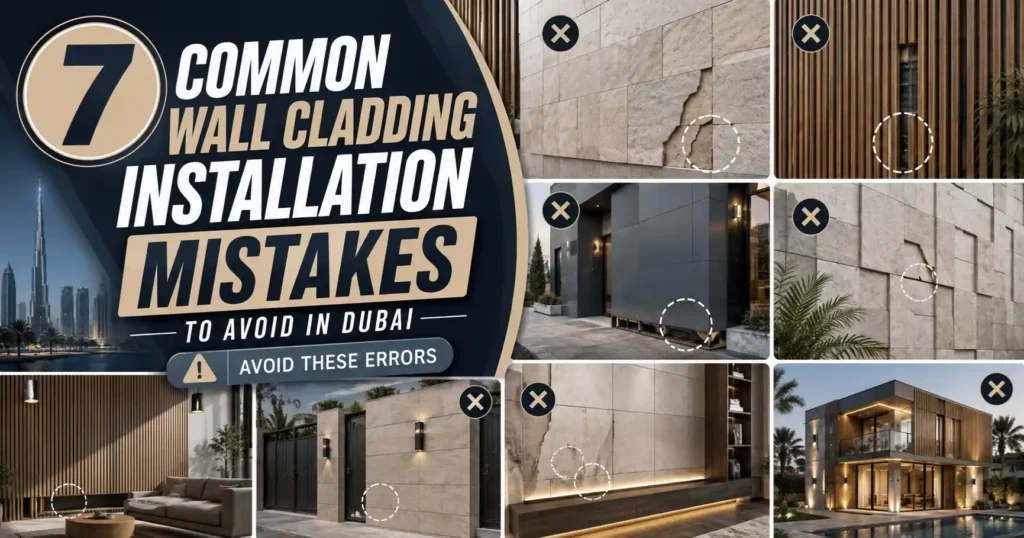
The big one: installing an interior-grade panel outdoors or in a wet room because it seemed similar enough to a certified product. Similar isn’t sufficient here. Another frequent slip is assuming “water-resistant” equals fully waterproof — it doesn’t. And concealing a wall that already has a leak or mould issue almost always worsens the underlying problem rather than solving it.
People also select a finish from a tiny sample without viewing it at scale, then get caught comparing a per-piece price against a per-m² price as though they’re equivalent. Skipping fire documentation for exterior or public-facing jobs, using the wrong adhesive, fitting timber or MDF without letting it acclimatise first — these mistakes surface months later, not on installation day. And failing to confirm in writing exactly what a quote includes causes more disputes than almost anything else on this list.
Questions to Ask Before You Approve a Quote
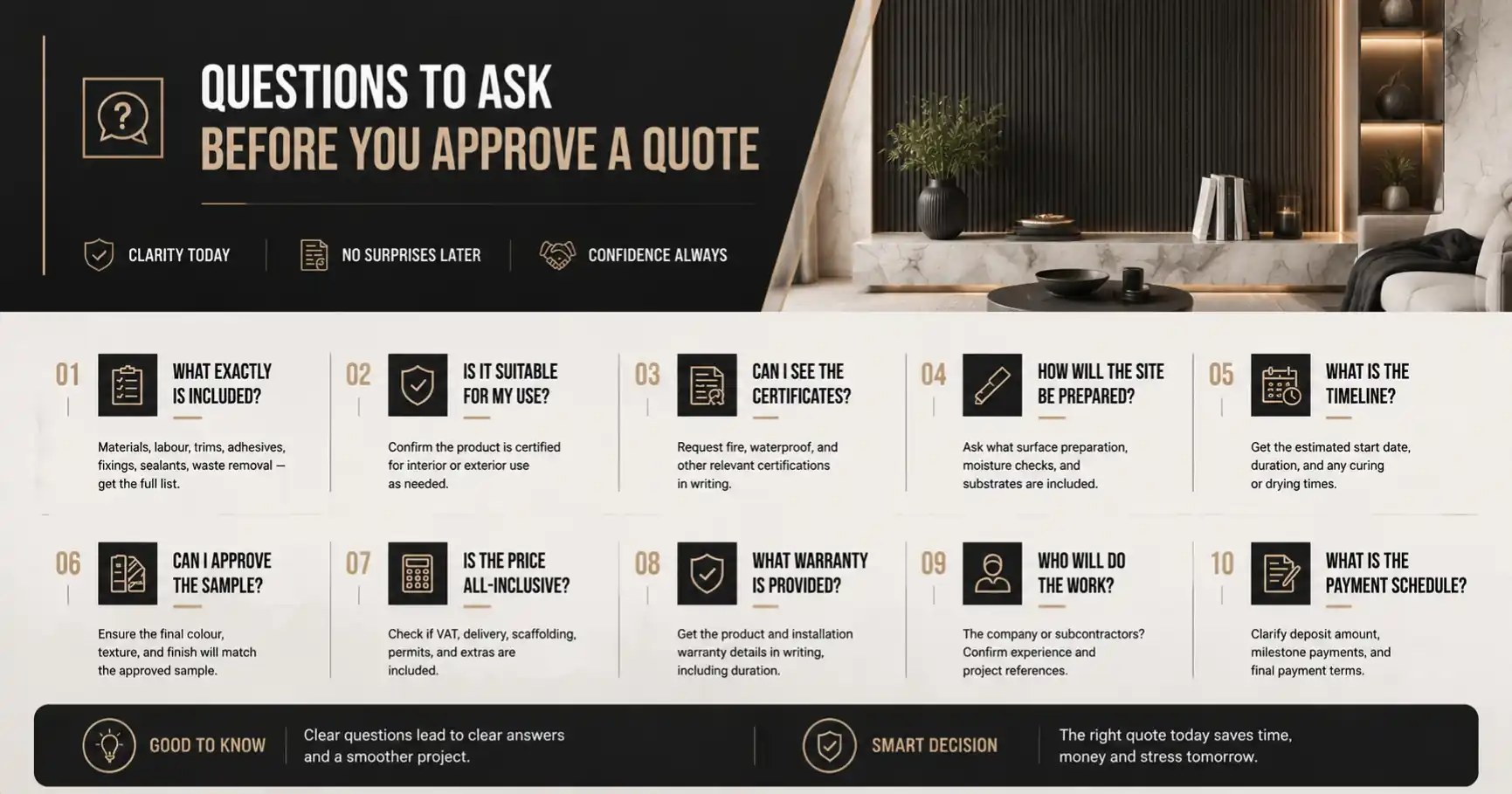
Secure the exact material, brand, and grade in writing. Confirm whether it’s genuinely certified for interior or exterior use — verified, not assumed. Request the fire classification certificate. Establish whether the price is material-only or includes fitting, and whether wall preparation and old-finish removal are part of that figure. Check that the subframe, adhesive, fixings, and trims are accounted for.
Then confirm VAT and delivery are included, how many days the job will take, what warranty covers workmanship versus the product itself, and whether you’ll get to approve the sample and colour before anything is ordered.
Frequently Asked Questions
Is wall cladding the same as wall panels?
Not exactly, but they overlap considerably. Cladding is typically a full covering system; a panel is one component, and a panel can readily form part of a cladding assembly.
Which is cheaper in Dubai, cladding or panels?
Basic panels like PVC are usually the most affordable, starting around AED 80–100 per m². Exterior cladding, such as aluminium or fibre cement, costs more, mainly due to subframes and fire testing.
Can panels be used outdoors in Dubai?
Yes, but only if that specific panel is engineered for exterior conditions — sun, moisture, sometimes fire. An ordinary interior panel simply isn’t built for it.
What material handles Dubai heat best?
There’s no clear winner, honestly. A quality, UV-stable product in almost any material — PVC, WPC, aluminium, fibre cement — can perform well if it’s manufactured and installed correctly.
Are PVC panels safe for bathrooms?
Many are, but only if that specific panel is certified for wet zones. Confirm with the supplier. Don’t assume every PVC panel is identical.
Do panels really block sound?
Only genuine acoustic panels with felt or foam backing actually absorb sound. An ordinary decorative panel won’t soundproof a room just by covering the surface.
Can cladding be fixed over a damaged wall?
It shouldn’t be. Resolve the dampness or damage first. Concealing the problem rather than addressing it usually worsens it over time.
How long does panel fitting take?
One feature wall, often in a single day. Larger rooms or commercial jobs, a few days — depends on wall condition and design complexity.
Is wall cladding fireproof?
Don’t assume so without evidence. Request the actual fire test certificate, particularly for anything intended for use on the building exterior.
Can panels be removed without damaging the wall?
Panels mounted on a frame or track come off more cleanly than fully bonded ones. Worth confirming with your installer upfront, especially if you’re renting.
Final Thoughts
Ultimately, wall cladding vs wall panels isn’t really a rivalry worth dwelling on. Cladding wins out for building exteriors, boundary walls, and anything facing the weather head-on. Panels win out for interior feature walls, media rooms, and quick upgrades where speed and design variety outweigh standing up to the elements.
And truthfully, the two blend together more often than not. A quality exterior-rated panel behaves exactly like cladding. Cladding turns up indoors purely for aesthetics all the time. What genuinely determines whether a project succeeds is the calibre of the material, the precision of the installation, and whether it truly suits your wall — not whichever term happened to appear on the price list.
Want to view samples, get an accurate measurement, or discuss a quote? You can request a free consultation or site visit.